
Pearson+ LogoPearson+ Logo
Ch. 37 Communities and Ecosystems
Taylor - Campbell Biology: Concepts & Connections 10th Edition
Taylor, Simon, Dickey, Hogan10th EditionCampbell Biology: Concepts & ConnectionsISBN: 9780136538783Not the one you use?Change textbook
Chapter 37, Problem 10

In Southeast Asia, there's an old saying: 'There is only one tiger to a hill.' In terms of energy flow in ecosystems, explain why big predatory animals such as tigers and sharks are relatively rare.

Verified step by step guidance
1
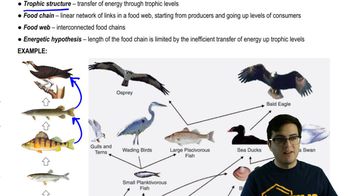
Understand the concept of energy flow in ecosystems: Energy flows through an ecosystem in a trophic structure, typically represented as a pyramid with primary producers at the base and top predators at the apex.
Recognize the role of trophic levels: In an ecosystem, energy is transferred from one trophic level to the next, starting from producers (plants) to primary consumers (herbivores), and then to secondary and tertiary consumers (carnivores and top predators like tigers and sharks).
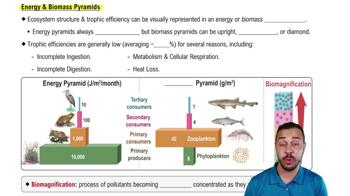
Learn about energy loss between trophic levels: Only about 10% of the energy from one trophic level is transferred to the next level. This is due to energy being lost as heat, used for metabolic processes, or not all of the biomass being consumed.
Apply the 10% rule to understand the rarity of top predators: Since each trophic level receives only about 10% of the energy from the level below it, top predators, which are often at the third or fourth trophic level, have much less available energy to support their populations.
Correlate energy availability with population size: With less energy available at higher trophic levels, fewer individuals can be supported, which explains why top predators like tigers and sharks are relatively rare in ecosystems.

Verified video answer for a similar problem:

This video solution was recommended by our tutors as helpful for the problem above.
Video duration:
2m
Was this helpful?

Key Concepts

Here are the essential concepts you must grasp in order to answer the question correctly.

Trophic Levels

Trophic levels represent the hierarchical positions in an ecosystem's food chain, where energy is transferred from one level to the next. Producers, such as plants, form the base, followed by primary consumers (herbivores), secondary consumers (carnivores), and apex predators. As energy moves up the trophic levels, it diminishes due to energy loss through metabolic processes, making higher-level predators like tigers and sharks less abundant.
Recommended video:
Guided course
03:14
Trophic Structure

Energy Pyramid

The energy pyramid illustrates the distribution of energy among different trophic levels in an ecosystem. Typically, only about 10% of the energy from one level is transferred to the next, leading to a decrease in biomass and population size as one moves up the pyramid. This inefficiency in energy transfer explains why large predators are fewer in number compared to their prey.
Recommended video:
Guided course
05:41
Energy & Biomass Pyramids

Carrying Capacity

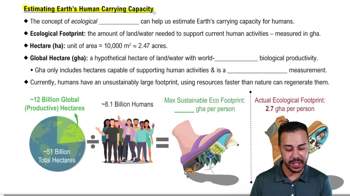
Carrying capacity refers to the maximum population size of a species that an environment can sustain indefinitely without degrading the habitat. For large predators, the carrying capacity is often low due to their high energy requirements and the limited availability of prey. This results in fewer individuals being able to thrive in a given area, contributing to their rarity in ecosystems.
Recommended video:
Guided course
06:24
Estimating Earth’s Human Carrying Capacity