Pearson+ LogoPearson+ Logo
Ch. 37 Communities and Ecosystems
Taylor - Campbell Biology: Concepts & Connections 10th Edition
Taylor, Simon, Dickey, Hogan10th EditionCampbell Biology: Concepts & ConnectionsISBN: 9780136538783Not the one you use?Change textbook
Chapter 37, Problem 7

The open ocean and tropical rain forests contribute the most to Earth's net primary production because
a. Both have high rates of net primary production
b. Both cover huge surface areas of Earth
c. Nutrients cycle fastest in these two ecosystems
d. The ocean covers a huge surface area, and the tropical rain-forest has a high rate of production

Verified step by step guidance
1
Understand the concept of net primary production (NPP): NPP is the amount of energy that plants and other photosynthetic organisms produce through photosynthesis, minus the energy they use for their own respiration. It represents the energy available to consumers in an ecosystem.
Analyze the characteristics of the open ocean: The open ocean covers a vast surface area of Earth, but its rate of net primary production per unit area is relatively low due to limited nutrient availability in many regions.
Analyze the characteristics of tropical rain forests: Tropical rain forests have a very high rate of net primary production per unit area because of abundant sunlight, water, and nutrients, but they cover a smaller surface area compared to the ocean.
Combine the contributions of both ecosystems: The open ocean contributes significantly to Earth's total NPP because of its massive surface area, while tropical rain forests contribute significantly due to their high productivity per unit area.
Evaluate the answer choices: Based on the above analysis, the correct answer is the one that acknowledges the ocean's large surface area and the tropical rain forest's high rate of production.

Verified video answer for a similar problem:

This video solution was recommended by our tutors as helpful for the problem above.
Video duration:
2m
Was this helpful?

Key Concepts

Here are the essential concepts you must grasp in order to answer the question correctly.

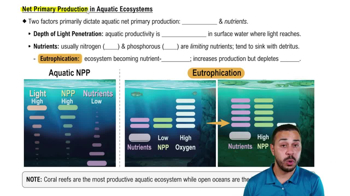
Net Primary Production (NPP)

Net Primary Production (NPP) refers to the amount of organic matter produced by photosynthetic organisms, minus the organic matter consumed by respiration. It is a crucial measure of ecosystem productivity, indicating how much energy is available to support the food web. High NPP is typically found in ecosystems with abundant sunlight and nutrients, such as tropical rainforests and coastal marine environments.
Recommended video:
Guided course
04:36
Primary Production in Aquatic Ecosystems

Ecosystem Surface Area

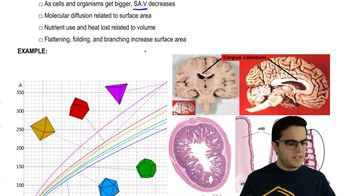
The surface area of an ecosystem plays a significant role in its overall productivity. Larger ecosystems, like the open ocean, can support vast populations of photosynthetic organisms, leading to higher total production. In contrast, smaller ecosystems may have limited production capacity, regardless of their productivity rates. Thus, both the size and productivity of an ecosystem are important for understanding its contribution to global NPP.
Recommended video:
Guided course
07:47
Surface Area to Volume Ratio

Nutrient Cycling

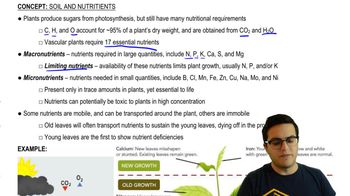
Nutrient cycling refers to the movement and exchange of organic and inorganic matter back into the production of living matter. In ecosystems like tropical rainforests, rapid decomposition and nutrient recycling support high rates of primary production. Conversely, while the open ocean may have slower nutrient cycling due to its vastness, upwelling zones can enhance nutrient availability, contributing to significant NPP in those areas.
Recommended video:
Guided course
03:25
Soil Nutrients