Pearson+ LogoPearson+ Logo
Ch. 38 Conservation Biology
Taylor - Campbell Biology: Concepts & Connections 10th Edition
Taylor, Simon, Dickey, Hogan10th EditionCampbell Biology: Concepts & ConnectionsISBN: 9780136538783Not the one you use?Change textbook
Chapter 38, Problem 6

Movement corridors are
a. The routes taken by migratory animals.
b. Strips or clumps of habitat that connect isolated fragments of habitat.
c. Landscapes that include several different ecosystems.
d. Edges, or boundaries, between ecosystems.

Verified step by step guidance
1
Understand the concept of movement corridors: Movement corridors are physical connections between isolated habitats that allow organisms to move between them. These corridors are crucial for maintaining biodiversity and enabling species to migrate, find resources, and reproduce.
Analyze the options provided in the problem: Each option describes a different ecological concept. For example, migratory routes (option a) refer to paths taken by animals during seasonal migrations, while edges (option d) refer to boundaries between ecosystems.
Focus on the definition of movement corridors: Movement corridors specifically refer to strips or clumps of habitat that connect isolated fragments of habitat, enabling species to traverse fragmented landscapes.
Compare the definition of movement corridors with the options: Identify which option aligns most closely with the definition of movement corridors. This involves matching the description of strips or clumps of habitat connecting isolated fragments to the correct option.
Select the correct answer based on the analysis: The correct answer is the option that matches the definition of movement corridors, which is option b.

Verified video answer for a similar problem:

This video solution was recommended by our tutors as helpful for the problem above.
Video duration:
3m
Was this helpful?

Key Concepts

Here are the essential concepts you must grasp in order to answer the question correctly.

Movement Corridors

Movement corridors are pathways that facilitate the movement of wildlife between isolated habitats. They are crucial for maintaining genetic diversity and enabling species to migrate in response to environmental changes. By connecting fragmented habitats, these corridors help prevent inbreeding and support the survival of various species.
Recommended video:
Guided course
08:52
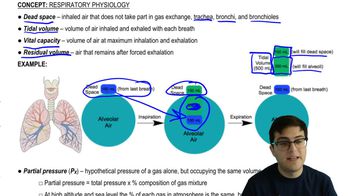
Air Movement and Partial Pressure

Habitat Fragmentation

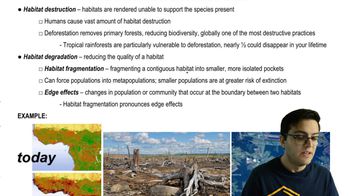
Habitat fragmentation occurs when large habitats are divided into smaller, isolated patches due to human activities or natural events. This process can lead to a decline in biodiversity, as species may struggle to find mates, food, or suitable living conditions. Understanding fragmentation is essential for conservation efforts aimed at preserving ecosystems and their inhabitants.
Recommended video:
Guided course
03:23
Habitat Destruction and Degradation

Ecosystem Connectivity

Ecosystem connectivity refers to the degree to which different habitats are linked, allowing for the movement of organisms and the flow of ecological processes. High connectivity enhances resilience against environmental changes and supports species migration, while low connectivity can lead to isolated populations. This concept is vital for effective conservation planning and management.
Recommended video:
Guided course
04:07
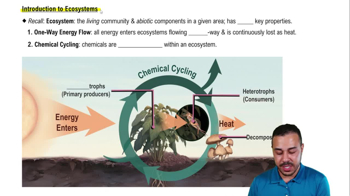
Introduction to Ecosystems
Related Practice
Textbook Question

Which of the following currently poses the single greatest threat to biodiversity?

a. Invasive species

b. Overhunting

c. Habitat loss

d. Pollution

1781
views
Textbook Question

Which of the following is characteristic of endemic species?

a. They are often found in biodiversity hot spots.

b. They are distributed widely in the biosphere.

c. They require edges between ecosystems.

d. They are often keystone species whose presence helps to structure a community.

1418
views
Textbook Question

Ospreys and other top predators are most severely affected by pesticides such as PCBs because they

a. Are especially sensitive to chemicals.

b. Have very long life spans.

c. Store the pesticides in their tissues.

d. Consume prey in which pesticides are concentrated.

888
views
Textbook Question

With limited resources, conservation biologists need to prioritize their efforts. Of the following choices, which should receive the greatest attention for the goal of conserving biodiversity?

a. A commercially important species

b. All endangered vertebrate species

c. A declining keystone species in a community

d. All endangered species

1317
views
Textbook Question
Which of the following statements about protected areas is not correct?a. We now protect 25% of the land areas of the planet.b. National parks are only one type of protected area.c. Most reserves are smaller in size than the ranges of some of the species they are meant to protect.d. Management of protected areas must coordinate with the management of lands outside the protected zone.
965
views
Textbook Question
What are the three levels of biological diversity? Explain how human activities threaten each of these levels.
1601
views