Pearson+ LogoPearson+ Logo
Ch. 38 Conservation Biology
Taylor - Campbell Biology: Concepts & Connections 10th Edition
Taylor, Simon, Dickey, Hogan10th EditionCampbell Biology: Concepts & ConnectionsISBN: 9780136538783Not the one you use?Change textbook
Chapter 38, Problem 5

Ospreys and other top predators are most severely affected by pesticides such as PCBs because they
a. Are especially sensitive to chemicals.
b. Have very long life spans.
c. Store the pesticides in their tissues.
d. Consume prey in which pesticides are concentrated.

Verified step by step guidance
1
Understand the concept of biomagnification: Biomagnification refers to the process by which the concentration of toxic substances, such as pesticides, increases as it moves up the food chain. Top predators, like ospreys, are most affected because they consume prey that has accumulated these substances.
Analyze the options provided: Each option represents a potential reason why ospreys and other top predators are severely affected by pesticides. Carefully evaluate each one based on biological principles.
Option a: 'Are especially sensitive to chemicals' - While sensitivity to chemicals can vary among species, this is not the primary reason top predators are affected by pesticides like PCBs. Sensitivity alone does not explain the accumulation of toxins.
Option b: 'Have very long life spans' - Long life spans can contribute to the accumulation of toxins over time, but this is not the main factor in why top predators are severely affected. The key lies in their position in the food chain.
Option c and d: 'Store the pesticides in their tissues' and 'Consume prey in which pesticides are concentrated' - These two options are closely related to biomagnification. Top predators consume prey that has already accumulated pesticides, leading to higher concentrations in their own tissues. This is the most biologically accurate explanation.

Verified video answer for a similar problem:

This video solution was recommended by our tutors as helpful for the problem above.
Video duration:
2m
Was this helpful?

Key Concepts

Here are the essential concepts you must grasp in order to answer the question correctly.

Bioaccumulation

Bioaccumulation refers to the process by which organisms accumulate toxic substances, such as pesticides, in their bodies over time. This occurs when the rate of intake of the substance exceeds the rate of elimination. In top predators like ospreys, this can lead to high concentrations of harmful chemicals, as they consume prey that has already accumulated these toxins.

Trophic Levels

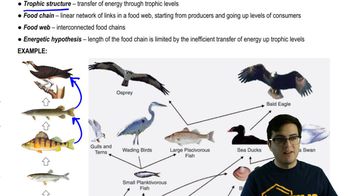
Trophic levels represent the hierarchical positions of organisms in a food chain, based on their feeding relationships. Ospreys, as top predators, occupy the highest trophic level, meaning they consume other organisms (like fish) that may have ingested pesticides. This positioning leads to increased exposure to toxins through a process known as biomagnification, where concentrations of harmful substances increase at each successive trophic level.
Recommended video:
Guided course
03:14
Trophic Structure

Chemical Sensitivity

Chemical sensitivity refers to the vulnerability of certain species to the effects of environmental pollutants. Ospreys and other top predators may exhibit heightened sensitivity to chemicals like PCBs due to their physiological traits and ecological roles. This sensitivity can result in adverse health effects, including reproductive issues and weakened immune responses, exacerbated by their long life spans and accumulation of toxins.
Recommended video:
Guided course
01:56
Chemical Reactions
Related Practice
Textbook Question

Which of these statements best describes what conservation biologists mean by 'the rapid loss of biodiversity'?

a. Introduced species, such as starlings and zebra mussels, have rapidly expanded their ranges.

b. Harvests of marine fishes, such as cod and bluefin tuna, are declining.

c. The current species extinction rate is as much as 100 times greater than at any time in the past 100,000 years.

d. Many potential medicines are being lost as plant species become extinct.

922
views
Textbook Question

Which of the following currently poses the single greatest threat to biodiversity?

a. Invasive species

b. Overhunting

c. Habitat loss

d. Pollution

1781
views
Textbook Question

Which of the following is characteristic of endemic species?

a. They are often found in biodiversity hot spots.

b. They are distributed widely in the biosphere.

c. They require edges between ecosystems.

d. They are often keystone species whose presence helps to structure a community.

1418
views
Textbook Question

Movement corridors are

a. The routes taken by migratory animals.

b. Strips or clumps of habitat that connect isolated fragments of habitat.

c. Landscapes that include several different ecosystems.

d. Edges, or boundaries, between ecosystems.

1109
views
Textbook Question

With limited resources, conservation biologists need to prioritize their efforts. Of the following choices, which should receive the greatest attention for the goal of conserving biodiversity?

a. A commercially important species

b. All endangered vertebrate species

c. A declining keystone species in a community

d. All endangered species

1317
views
Textbook Question
Which of the following statements about protected areas is not correct?a. We now protect 25% of the land areas of the planet.b. National parks are only one type of protected area.c. Most reserves are smaller in size than the ranges of some of the species they are meant to protect.d. Management of protected areas must coordinate with the management of lands outside the protected zone.
965
views