Pearson+ LogoPearson+ Logo
Ch. 15 Tracing Evolutionary History
Taylor - Campbell Biology: Concepts & Connections 10th Edition
Taylor, Simon, Dickey, Hogan10th EditionCampbell Biology: Concepts & ConnectionsISBN: 9780136538783Not the one you use?Change textbook
Chapter 15, Problem 14

Explain why changes in the regulation of developmental genes may have played such a large role in the evolution of new forms.

Verified step by step guidance
1
Understand that developmental genes are responsible for controlling the growth, differentiation, and organization of cells and tissues during an organism's development. These genes often act as 'master regulators' by turning other genes on or off at specific times and locations.
Recognize that small changes in the regulation of these developmental genes (e.g., when, where, and how strongly they are expressed) can lead to significant changes in an organism's morphology or structure without altering the underlying DNA sequence of the protein-coding regions.
Consider that such regulatory changes can produce novel traits or forms by modifying existing developmental pathways. For example, altering the expression of a gene involved in limb development could result in changes to limb size, shape, or number.
Understand that these changes are often subject to natural selection. If a regulatory change provides a survival or reproductive advantage, it may become more common in a population over time, contributing to evolutionary diversification.
Reflect on examples from evolutionary biology, such as the role of Hox genes in determining body plans or the changes in regulatory genes that led to the evolution of finches' beak shapes. These examples illustrate how modifications in gene regulation can drive the evolution of new forms and adaptations.

Verified video answer for a similar problem:

This video solution was recommended by our tutors as helpful for the problem above.
Video duration:
4m
Was this helpful?

Key Concepts

Here are the essential concepts you must grasp in order to answer the question correctly.

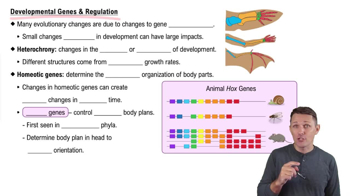
Developmental Genes

Developmental genes are crucial for the regulation of an organism's growth and development. They control processes such as cell differentiation, tissue formation, and organ development. Changes in these genes can lead to significant alterations in an organism's morphology and function, which can drive evolutionary changes.
Recommended video:
06:12
Developmental Genes & Regulation

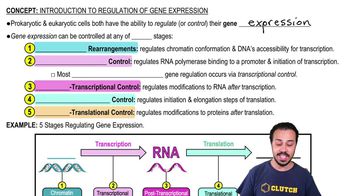
Gene Regulation

Gene regulation refers to the mechanisms that control the expression of genes, determining when and how much of a gene product is made. This regulation can occur at various levels, including transcription, translation, and post-translational modifications. Variations in gene regulation can result in different phenotypes, contributing to the diversity of forms seen in evolution.
Recommended video:
Guided course
06:40
Introduction to Regulation of Gene Expression

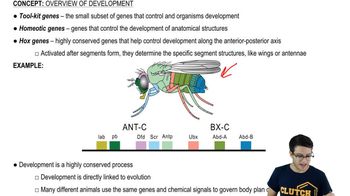
Evolutionary Developmental Biology (Evo-Devo)

Evolutionary Developmental Biology, or Evo-Devo, is a field that studies the relationship between the development of organisms and their evolutionary processes. It emphasizes how changes in developmental pathways and gene regulation can lead to the emergence of new traits and species. This perspective helps explain how small genetic changes can have profound effects on the evolution of new forms.
Recommended video: