Pearson+ LogoPearson+ Logo
Ch. 15 Tracing Evolutionary History
Taylor - Campbell Biology: Concepts & Connections 10th Edition
Taylor, Simon, Dickey, Hogan10th EditionCampbell Biology: Concepts & ConnectionsISBN: 9780136538783Not the one you use?Change textbook
Chapter 15, Problem 11

Distinguish between microevolution and macroevolution.

Verified step by step guidance
1
Microevolution refers to small-scale changes in allele frequencies within a population over a relatively short period of time. These changes are often driven by mechanisms such as mutation, natural selection, genetic drift, and gene flow.
Macroevolution involves large-scale evolutionary changes that occur over long periods of time, leading to the emergence of new species, genera, families, or higher taxonomic groups. It encompasses processes like speciation and extinction.
Microevolution is typically studied within populations and focuses on genetic variation and adaptation to environmental pressures, while macroevolution examines broader patterns and trends in the history of life, often using fossil records and phylogenetic analysis.
Both microevolution and macroevolution are interconnected; microevolutionary changes accumulate over time and can lead to macroevolutionary events, such as the formation of new species.
Understanding the distinction between microevolution and macroevolution helps biologists study evolutionary processes at different scales, providing insights into both short-term adaptations and long-term evolutionary history.

Verified video answer for a similar problem:

This video solution was recommended by our tutors as helpful for the problem above.
Video duration:
2m
Was this helpful?

Key Concepts

Here are the essential concepts you must grasp in order to answer the question correctly.

Microevolution

Microevolution refers to small-scale evolutionary changes that occur within a population over a relatively short period. These changes can involve alterations in allele frequencies due to mechanisms such as natural selection, genetic drift, mutation, and gene flow. An example of microevolution is the development of antibiotic resistance in bacteria, where specific traits become more common in response to environmental pressures.
Recommended video:
03:03
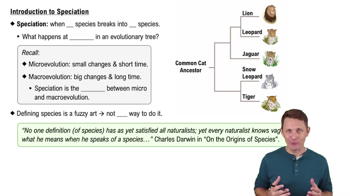
Introduction to Speciation

Macroevolution

Macroevolution encompasses large-scale evolutionary changes that occur over long periods, often leading to the emergence of new species or groups. This concept includes processes such as speciation, extinction, and the evolution of major taxonomic groups. An example of macroevolution is the diversification of mammals after the extinction of dinosaurs, which led to the development of various mammalian species adapted to different environments.
Recommended video:
03:03
Introduction to Speciation

Speciation

Speciation is the evolutionary process through which new biological species arise. It typically occurs when populations of a species become isolated from one another, leading to genetic divergence due to different selective pressures or genetic drift. This can result in reproductive barriers, ultimately preventing interbreeding and allowing the populations to evolve into distinct species, exemplified by the formation of Darwin's finches on the Galápagos Islands.
Recommended video:
Guided course
02:53
Allopatric Speciation