

Pearson+ LogoPearson+ Logo
Ch. 15 Tracing Evolutionary History
Taylor - Campbell Biology: Concepts & Connections 10th Edition
Taylor, Simon, Dickey, Hogan10th EditionCampbell Biology: Concepts & ConnectionsISBN: 9780136538783Not the one you use?Change textbook
Chapter 15, Problem 9

Which of the following could provide the best data for determining the phylogeny of very closely related species?
a. The fossil record
b. Their morphological differences and similarities
c. A comparison of nucleotide sequences in homologous genes and mitochondrial DNA
d. A comparison of their ribosomal DNA sequences

Verified step by step guidance
1
Understand the problem: The question is asking which type of data would be most effective for determining the phylogeny (evolutionary relationships) of very closely related species. Phylogeny is often determined by analyzing traits or genetic information that can reveal evolutionary connections.
Review the options: (a) The fossil record, (b) Morphological differences and similarities, (c) Nucleotide sequences in homologous genes and mitochondrial DNA, and (d) Ribosomal DNA sequences. Each of these provides different types of information about species' evolutionary history.
Evaluate the fossil record (option a): Fossil records are useful for studying long-term evolutionary changes and extinct species, but they may not provide detailed information for very closely related species, as these species often have limited or no fossil differences.
Evaluate morphological differences (option b): Morphological traits (physical characteristics) can be influenced by environmental factors and convergent evolution, making them less reliable for distinguishing very closely related species.
Evaluate genetic data (options c and d): Genetic data, such as nucleotide sequences in homologous genes and mitochondrial DNA (option c), or ribosomal DNA sequences (option d), are highly specific and can reveal small differences between closely related species. Mitochondrial DNA evolves relatively quickly, making it particularly useful for studying recent evolutionary events, while ribosomal DNA evolves more slowly and is better suited for studying distant relationships.

Verified video answer for a similar problem:

This video solution was recommended by our tutors as helpful for the problem above.
Video duration:
3m
Was this helpful?

Key Concepts

Here are the essential concepts you must grasp in order to answer the question correctly.

Phylogeny

Phylogeny refers to the evolutionary history and relationships among species or groups of organisms. It is often depicted as a phylogenetic tree, which illustrates how species diverged from common ancestors over time. Understanding phylogeny is crucial for determining the evolutionary pathways and connections between closely related species.
Recommended video:
Guided course
09:32
Taxonomy and Phylogeny

Molecular Phylogenetics

Molecular phylogenetics is a method that uses genetic data, such as nucleotide sequences from DNA or RNA, to infer the evolutionary relationships among species. By comparing homologous genes and mitochondrial DNA, researchers can identify genetic similarities and differences that provide insights into the evolutionary history of organisms, making it a powerful tool for studying closely related species.
Recommended video:
05:13
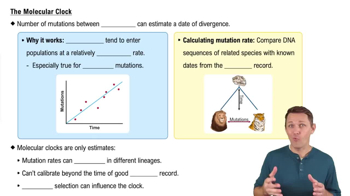
The Molecular Clock

Homologous Genes

Homologous genes are genes that share a common ancestry and have similar sequences due to evolutionary divergence. These genes can be used to trace evolutionary relationships because their similarities indicate a shared lineage. Analyzing homologous genes is particularly effective in determining phylogenetic relationships among closely related species, as it reveals how genetic changes have occurred over time.
Recommended video:
Guided course
08:09
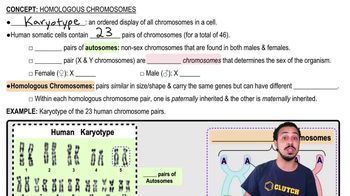
Homologous Chromosomes