Pearson+ LogoPearson+ Logo
Ch. 15 Tracing Evolutionary History
Taylor - Campbell Biology: Concepts & Connections 10th Edition
Taylor, Simon, Dickey, Hogan10th EditionCampbell Biology: Concepts & ConnectionsISBN: 9780136538783Not the one you use?Change textbook
Chapter 15, Problem 2

Fill in this concept map about systematics.
Concept map illustrating systematics in phylogeny with labeled sections for completion.

Verified step by step guidance
1
Step 1: Start by identifying the main concept, 'Systematics,' which is the study of evolutionary relationships among organisms.
Step 2: For box (a), recognize that evolutionary history is called 'phylogeny,' which traces the lineage and relationships of organisms.
Step 3: For box (b), evolutionary history is based on 'morphological and molecular data,' which includes physical traits and genetic information.
Step 4: For box (c), the images of limbs represent 'homologous structures,' which are anatomical features shared due to common ancestry.
Step 5: For box (e), evolutionary relationships are shown in 'phylogenetic trees,' which visually represent hypotheses about the evolutionary connections among species.

Verified video answer for a similar problem:

This video solution was recommended by our tutors as helpful for the problem above.
Video duration:
2m
Was this helpful?

Key Concepts

Here are the essential concepts you must grasp in order to answer the question correctly.

Systematics

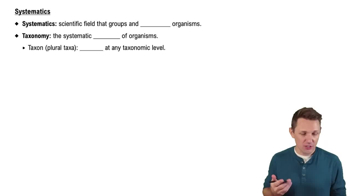
Systematics is a branch of biology that deals with the classification and evolutionary relationships among organisms. It aims to understand the diversity of life by tracing the evolutionary history of species and generating hypotheses about their relationships. This field combines data from various sources, including morphology, genetics, and fossil records, to construct phylogenetic trees that illustrate these relationships.
Recommended video:
06:57
Systematics

Cladistics

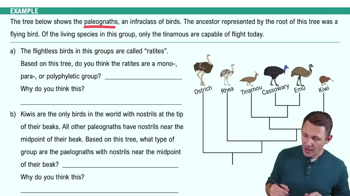
Cladistics is a method within systematics that classifies organisms based on shared derived characteristics, known as synapomorphies. This approach emphasizes the importance of evolutionary lineage and aims to create a branching diagram, or cladogram, that reflects the evolutionary pathways of different species. Cladistics helps in identifying groups of organisms that share a common ancestor, thus providing insights into their evolutionary history.
Recommended video:
03:52
Cladistics Example 1

Phylogenetic Trees

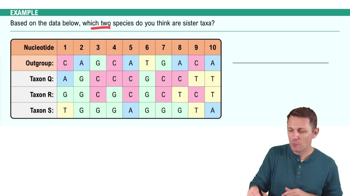
Phylogenetic trees are graphical representations that depict the evolutionary relationships among various species or groups. They illustrate how species diverged from common ancestors over time, with branches representing lineages and nodes indicating points of divergence. These trees are constructed using data from morphological traits, genetic sequences, and fossil evidence, allowing scientists to visualize and analyze the evolutionary history of life on Earth.
Recommended video:
04:13
Building Phylogenetic Trees Example 2