Pearson+ LogoPearson+ Logo
Ch. 15 Tracing Evolutionary History
Taylor - Campbell Biology: Concepts & Connections 10th Edition
Taylor, Simon, Dickey, Hogan10th EditionCampbell Biology: Concepts & ConnectionsISBN: 9780136538783Not the one you use?Change textbook
Chapter 15, Problem 4

Ancient photosynthetic prokaryotes were very important in the history of life because they
a. Produced the oxygen in the atmosphere.
b. Are the oldest-known archaea.
c. Were the first multicellular organisms.
d. Showed that life could evolve around deep-sea vents.

Verified step by step guidance
1
Understand the significance of ancient photosynthetic prokaryotes: These organisms were among the first to perform photosynthesis, a process that converts light energy into chemical energy and releases oxygen as a byproduct.
Recall the role of photosynthesis in Earth's history: Photosynthesis by ancient prokaryotes, such as cyanobacteria, led to the accumulation of oxygen in the atmosphere, a phenomenon known as the Great Oxygenation Event.
Eliminate incorrect options: Option b ('oldest-known archaea') is incorrect because photosynthetic prokaryotes like cyanobacteria are not archaea but bacteria. Option c ('first multicellular organisms') is incorrect because these prokaryotes are unicellular. Option d ('life evolving around deep-sea vents') is unrelated to photosynthesis.
Focus on the correct option: Option a ('produced the oxygen in the atmosphere') aligns with the historical importance of photosynthetic prokaryotes in oxygenating Earth's atmosphere.
Conclude the reasoning: Ancient photosynthetic prokaryotes were crucial for enabling aerobic life forms to evolve by increasing oxygen levels in the atmosphere, transforming Earth's environment.

Verified video answer for a similar problem:

This video solution was recommended by our tutors as helpful for the problem above.
Video duration:
1m
Was this helpful?

Key Concepts

Here are the essential concepts you must grasp in order to answer the question correctly.

Photosynthesis

Photosynthesis is the process by which organisms, primarily plants and certain prokaryotes, convert light energy into chemical energy, using carbon dioxide and water to produce glucose and oxygen. This process is crucial for life on Earth as it forms the base of the food chain and contributes to the oxygen content of the atmosphere.
Recommended video:
Guided course
05:58
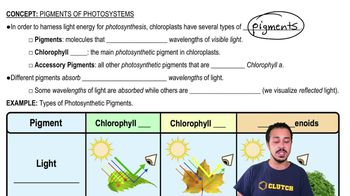
Pigments of Photosynthesis

Oxygen Production

Ancient photosynthetic prokaryotes, such as cyanobacteria, played a pivotal role in producing oxygen during the Great Oxygenation Event. This increase in atmospheric oxygen allowed for the evolution of aerobic organisms and significantly changed the planet's environment, making it more conducive to complex life forms.
Recommended video:
Guided course
04:36
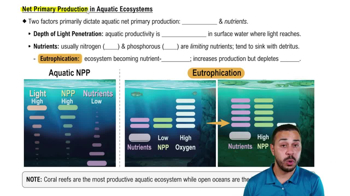
Primary Production in Aquatic Ecosystems

Evolution of Life

The evolution of life on Earth is marked by significant milestones, including the emergence of prokaryotic life forms. These organisms laid the groundwork for more complex life through processes such as natural selection and genetic variation, ultimately leading to the diversity of life we see today.
Recommended video:
Guided course
09:26
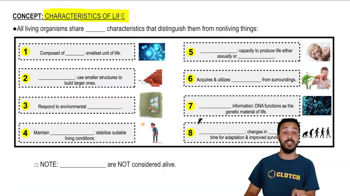
Characteristics of Life
Related Practice
Textbook Question

Using the figure below, describe the stages that may have led to the origin of life.

1032
views
Textbook Question

Fill in this concept map about systematics.

1304
views
Textbook Question

You set your time machine for 3 billion years ago and push the start button. When the dust clears, you look out the window. Which of the following describes what you would probably see?

a. A cloud of gas and dust in space

b. Green scum in the water

c. Land and water sterile and devoid of life

d. An endless expanse of red-hot molten rock

856
views
Textbook Question

The animals and plants of India are very different from the species in nearby Southeast Asia. Why might this be true?

a. India was once covered by oceans and Asia was not.

b. India is in the process of separating from the rest of Asia.

c. Life in India was wiped out by ancient volcanic eruptions.

d. India was a separate continent until about 45 million years ago.

943
views
Textbook Question

Adaptive radiations may be promoted by all of the following except one. Which one?

a. Mass extinctions that result in vacant ecological niches

b. Colonization of an isolated region with few competitors

c. A gradual change in climate

d. A novel adaptation

1208
views
Textbook Question

A swim bladder is a gas-filled sac that helps fish maintain buoyancy. Evidence indicates that early fish gulped air into primitive lungs, helping them survive in stagnant waters. The evolution of the swim bladder from lungs of an ancestral fish is an example of

a. An evolutionary trend.

b. Paedomorphosis.

c. The gradual refinement of a structure with the same function.

d. Exaptation.

1988
views