Pearson+ LogoPearson+ Logo
Ch. 15 Tracing Evolutionary History
Taylor - Campbell Biology: Concepts & Connections 10th Edition
Taylor, Simon, Dickey, Hogan10th EditionCampbell Biology: Concepts & ConnectionsISBN: 9780136538783Not the one you use?Change textbook
Chapter 15, Problem 3

You set your time machine for 3 billion years ago and push the start button. When the dust clears, you look out the window. Which of the following describes what you would probably see?
a. A cloud of gas and dust in space
b. Green scum in the water
c. Land and water sterile and devoid of life
d. An endless expanse of red-hot molten rock

Verified step by step guidance
1
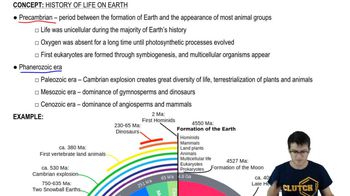
Step 1: Understand the timeline of Earth's history. Approximately 3 billion years ago, Earth was in the Archean Eon, a time when life was beginning to emerge, but the planet was still very different from what we see today.
Step 2: Recall the conditions of early Earth during the Archean Eon. The atmosphere lacked oxygen, and the surface was dominated by oceans. Life, if present, was primarily microbial and likely confined to aquatic environments.
Step 3: Consider the types of life that existed during this time. Cyanobacteria, also known as blue-green algae, were among the first photosynthetic organisms. They formed structures called stromatolites, which contributed to the production of oxygen over time.
Step 4: Eliminate options that do not align with the conditions of 3 billion years ago. For example, a cloud of gas and dust (option a) describes the formation of the solar system, which occurred much earlier. An endless expanse of red-hot molten rock (option d) refers to the Hadean Eon, which predates the Archean. Land and water sterile and devoid of life (option c) does not account for the presence of microbial life.
Step 5: Conclude that the most likely scenario is the presence of green scum in the water (option b), representing microbial life such as cyanobacteria, which were thriving in aquatic environments during this time.

Verified video answer for a similar problem:

This video solution was recommended by our tutors as helpful for the problem above.
Video duration:
1m
Was this helpful?

Key Concepts

Here are the essential concepts you must grasp in order to answer the question correctly.

Early Earth Conditions

Three billion years ago, Earth was in its early stages of development. The planet was characterized by extreme volcanic activity, a lack of stable landmasses, and a predominantly inhospitable environment. The atmosphere was likely rich in carbon dioxide and lacked free oxygen, making it unsuitable for most modern life forms.
Recommended video:
Guided course
07:07
Timeline of Life on Earth

Origin of Life

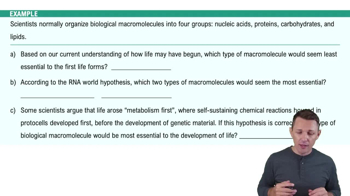
The origin of life on Earth is believed to have occurred around 3.5 to 4 billion years ago, with simple prokaryotic organisms emerging in primordial environments. These early life forms were likely anaerobic and relied on chemical processes for energy, thriving in oceans or hydrothermal vents, rather than on land.
Recommended video:
03:23
Origin of Life Example 1

Geological Time Scale

The geological time scale divides Earth's history into different periods based on significant geological and biological events. The time frame of 3 billion years ago falls within the Archean Eon, a time when the Earth's crust was forming, and life was just beginning to emerge, leading to a landscape that was vastly different from today.
Recommended video: