Pearson+ LogoPearson+ Logo
Ch. 15 Tracing Evolutionary History
Taylor - Campbell Biology: Concepts & Connections 10th Edition
Taylor, Simon, Dickey, Hogan10th EditionCampbell Biology: Concepts & ConnectionsISBN: 9780136538783Not the one you use?Change textbook
Chapter 15, Problem 7

A swim bladder is a gas-filled sac that helps fish maintain buoyancy. Evidence indicates that early fish gulped air into primitive lungs, helping them survive in stagnant waters. The evolution of the swim bladder from lungs of an ancestral fish is an example of
a. An evolutionary trend.
b. Paedomorphosis.
c. The gradual refinement of a structure with the same function.
d. Exaptation.

Verified step by step guidance
1
Understand the concept of exaptation: Exaptation refers to a trait that evolves for one function but is later co-opted for a different function. In this case, the lungs of ancestral fish evolved to help them survive in stagnant waters but were later adapted into swim bladders for buoyancy.
Analyze the evolutionary process described: The problem mentions that the swim bladder evolved from lungs, which indicates a change in function over time. This aligns with the concept of exaptation.
Compare the other options: a) An evolutionary trend refers to a general direction of change in traits over time, which is not specific to the functional shift described here. b) Paedomorphosis refers to the retention of juvenile traits in adult organisms, which is unrelated to the transformation of lungs into swim bladders. c) Gradual refinement of a structure with the same function does not apply because the function changed from respiration to buoyancy.
Focus on the correct answer: The transformation of lungs into swim bladders represents a shift in function, which is characteristic of exaptation.
Conclude that the correct answer is d. exaptation, based on the evidence provided and the definition of the term.

Verified video answer for a similar problem:

This video solution was recommended by our tutors as helpful for the problem above.
Video duration:
47s
Was this helpful?

Key Concepts

Here are the essential concepts you must grasp in order to answer the question correctly.

Evolutionary Trend

An evolutionary trend refers to a general direction in which a species or group of organisms evolves over time, often leading to increased complexity or adaptation to specific environments. In the context of the swim bladder, it highlights how certain traits can become more pronounced or refined as species adapt to their ecological niches.
Recommended video:
02:45
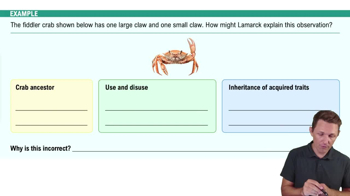
History of Evolutionary Theory Example 1

Exaptation

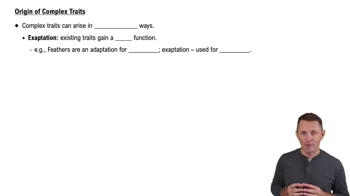
Exaptation is a process in evolution where a trait that originally evolved for one function is co-opted for a different purpose. The swim bladder's evolution from primitive lungs exemplifies exaptation, as the original function of gas exchange in lungs was repurposed to aid in buoyancy control in aquatic environments.
Recommended video:
06:15
Origin of Complex Traits

Gradual Refinement

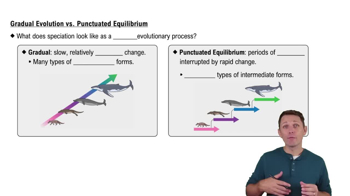
Gradual refinement refers to the slow and continuous process of change in a biological structure or function over generations. This concept is crucial in understanding how the swim bladder evolved from lungs, as it illustrates how small, incremental changes can lead to significant adaptations that enhance survival in specific habitats.
Recommended video:
03:23
Gradual Evolution vs. Punctuated Equilibrium
Related Practice
Textbook Question

Ancient photosynthetic prokaryotes were very important in the history of life because they

a. Produced the oxygen in the atmosphere.

b. Are the oldest-known archaea.

c. Were the first multicellular organisms.

d. Showed that life could evolve around deep-sea vents.

1389
views
Textbook Question

The animals and plants of India are very different from the species in nearby Southeast Asia. Why might this be true?

a. India was once covered by oceans and Asia was not.

b. India is in the process of separating from the rest of Asia.

c. Life in India was wiped out by ancient volcanic eruptions.

d. India was a separate continent until about 45 million years ago.

943
views
Textbook Question

Adaptive radiations may be promoted by all of the following except one. Which one?

a. Mass extinctions that result in vacant ecological niches

b. Colonization of an isolated region with few competitors

c. A gradual change in climate

d. A novel adaptation

1208
views
Textbook Question

If you were using cladistics to build a phylogenetic tree of cats, which would be the best choice for an outgroup?

a. Kangaroo

b. Leopard

c. Domestic cat

d. Iguana

1588
views
Textbook Question

Which of the following could provide the best data for determining the phylogeny of very closely related species?

a. The fossil record

b. Their morphological differences and similarities

c. A comparison of nucleotide sequences in homologous genes and mitochondrial DNA

d. A comparison of their ribosomal DNA sequences

1114
views
Textbook Question

Major divisions in the geologic record are marked by

a. Radioactive dating.

b. Distinct changes in the types of fossilized life.

c. Regular time intervals measured in millions of years.

d. The appearance, in order, of prokaryotes, eukaryotes, protists, animals, plants, and fungi.

875
views