Pearson+ LogoPearson+ Logo
Ch. 15 Tracing Evolutionary History
Taylor - Campbell Biology: Concepts & Connections 10th Edition
Taylor, Simon, Dickey, Hogan10th EditionCampbell Biology: Concepts & ConnectionsISBN: 9780136538783Not the one you use?Change textbook
Chapter 15, Problem 5

The animals and plants of India are very different from the species in nearby Southeast Asia. Why might this be true?
a. India was once covered by oceans and Asia was not.
b. India is in the process of separating from the rest of Asia.
c. Life in India was wiped out by ancient volcanic eruptions.
d. India was a separate continent until about 45 million years ago.

Verified step by step guidance
1
Understand the context of the question: The problem is asking why the species of animals and plants in India differ significantly from those in nearby Southeast Asia. This requires knowledge of biogeography and Earth's geological history.
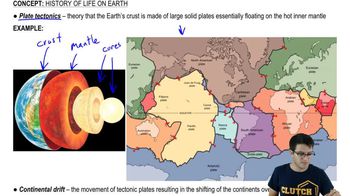
Recall the concept of plate tectonics: Earth's crust is divided into tectonic plates that move over time. These movements can cause continents to drift apart or collide, influencing the distribution of species.
Consider the history of India's geological position: India was once part of the supercontinent Gondwana, which included Africa, South America, Antarctica, and Australia. Around 120 million years ago, India began to drift northward as a separate landmass.
Recognize the significance of India's isolation: While India was a separate continent, its flora and fauna evolved independently, leading to unique species. About 45 million years ago, India collided with Asia, forming the Himalayas and allowing some species exchange, but the distinct evolutionary history remained.
Evaluate the options: Based on the geological history, the correct explanation is that India was a separate continent until about 45 million years ago, which explains the differences in species between India and Southeast Asia.

Verified video answer for a similar problem:

This video solution was recommended by our tutors as helpful for the problem above.
Video duration:
2m
Was this helpful?

Key Concepts

Here are the essential concepts you must grasp in order to answer the question correctly.

Plate Tectonics

Plate tectonics is the scientific theory that describes the large-scale movement of Earth's lithosphere, which is divided into tectonic plates. These plates float on the semi-fluid asthenosphere beneath them and can collide, separate, or slide past each other. This movement can lead to the formation of continents, mountains, and ocean basins, significantly influencing the distribution of species and ecosystems.
Recommended video:
Guided course
04:33
Plate Tectonics and Continental Drift

Biogeography

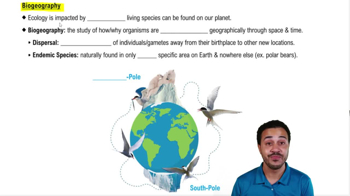
Biogeography is the study of the distribution of species and ecosystems in geographic space and through geological time. It examines how historical events, such as continental drift and climate changes, have shaped the biodiversity of regions. Understanding biogeography helps explain why certain species are found in specific areas and how geographical barriers can lead to distinct evolutionary paths.
Recommended video:

Evolutionary Isolation

Evolutionary isolation occurs when populations of organisms are separated by geographical barriers, leading to divergent evolution. This isolation can result in the development of unique species adapted to their specific environments. In the case of India, its historical separation from other landmasses allowed for the evolution of distinct flora and fauna, contributing to the biodiversity observed today.
Recommended video:
02:45
History of Evolutionary Theory Example 1
Related Practice
Textbook Question

Fill in this concept map about systematics.

1304
views
Textbook Question

You set your time machine for 3 billion years ago and push the start button. When the dust clears, you look out the window. Which of the following describes what you would probably see?

a. A cloud of gas and dust in space

b. Green scum in the water

c. Land and water sterile and devoid of life

d. An endless expanse of red-hot molten rock

856
views
Textbook Question

Ancient photosynthetic prokaryotes were very important in the history of life because they

a. Produced the oxygen in the atmosphere.

b. Are the oldest-known archaea.

c. Were the first multicellular organisms.

d. Showed that life could evolve around deep-sea vents.

1389
views
Textbook Question

Adaptive radiations may be promoted by all of the following except one. Which one?

a. Mass extinctions that result in vacant ecological niches

b. Colonization of an isolated region with few competitors

c. A gradual change in climate

d. A novel adaptation

1208
views
Textbook Question

A swim bladder is a gas-filled sac that helps fish maintain buoyancy. Evidence indicates that early fish gulped air into primitive lungs, helping them survive in stagnant waters. The evolution of the swim bladder from lungs of an ancestral fish is an example of

a. An evolutionary trend.

b. Paedomorphosis.

c. The gradual refinement of a structure with the same function.

d. Exaptation.

1988
views
Textbook Question

If you were using cladistics to build a phylogenetic tree of cats, which would be the best choice for an outgroup?

a. Kangaroo

b. Leopard

c. Domestic cat

d. Iguana

1588
views