
Pearson+ LogoPearson+ Logo
Ch. 11 How Genes Are Controlled
Taylor - Campbell Biology: Concepts & Connections 10th Edition
Taylor, Simon, Dickey, Hogan10th EditionCampbell Biology: Concepts & ConnectionsISBN: 9780136538783Not the one you use?Change textbook
Chapter 11, Problem 6

Your bone cells, muscle cells, and skin cells look different because
a. Each cell contains different kinds of genes.
b. They are present in different organs.
c. Different genes are active in each kind of cell.
d. They contain different numbers of genes.

Verified step by step guidance
1
Understand that all cells in an organism contain the same DNA, meaning they have the same set of genes. This is a fundamental concept in biology known as genomic equivalence.
Recognize that the differences in appearance and function between bone cells, muscle cells, and skin cells are not due to differences in the genes they contain, but rather how those genes are expressed.
Learn that gene expression refers to the process by which information from a gene is used to produce a functional product, such as a protein. Not all genes are active (expressed) in every cell type.
Realize that specific genes are turned on or off in different cell types depending on the cell's function. For example, muscle cells express genes related to contraction, while bone cells express genes related to mineralization.
Conclude that the correct answer is related to the regulation of gene activity, as different genes are active in each kind of cell, allowing them to perform specialized functions.

Verified video answer for a similar problem:

This video solution was recommended by our tutors as helpful for the problem above.
Video duration:
1m
Was this helpful?

Key Concepts

Here are the essential concepts you must grasp in order to answer the question correctly.

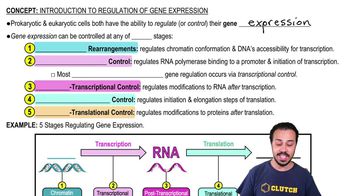
Gene Expression

Gene expression is the process by which information from a gene is used to synthesize a functional gene product, typically proteins. Different cells express different sets of genes, leading to the production of specific proteins that determine the cell's structure and function. This selective expression is crucial for the differentiation of various cell types, such as bone, muscle, and skin cells.
Recommended video:
Guided course
06:40
Introduction to Regulation of Gene Expression

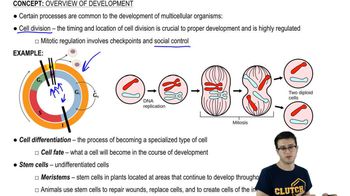
Cell Differentiation

Cell differentiation is the process by which a less specialized cell becomes a more specialized cell type. During development, stem cells undergo differentiation to form various cell types, each with distinct functions and characteristics. This process is influenced by gene expression patterns, which dictate the specific proteins produced in each cell type.
Recommended video:
Guided course
05:28
Cell Division and Differentiation

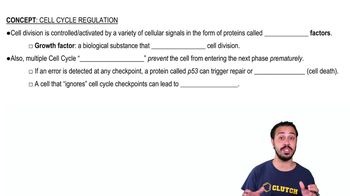
Genetic Regulation

Genetic regulation refers to the mechanisms that control the expression of genes within a cell. This regulation can occur at various levels, including transcriptional, post-transcriptional, and translational stages. Factors such as transcription factors, enhancers, and silencers play a role in determining which genes are active in a given cell type, contributing to the diversity of cell functions and appearances.
Recommended video:
Guided course
03:31
Cell Cycle Regulation
Related Practice
Textbook Question

A homeotic gene does which of the following?

a. It serves as the ultimate control for prokaryotic operons.

b. It regulates the expression of groups of other genes during development.

c. It represses the histone proteins in eukaryotic chromosomes.

d. It helps splice mRNA after transcription.

1022
views
Textbook Question

Which of the following is a valid difference between embryonic stem cells and the stem cells found in adult tissues?

a. In laboratory culture, only adult stem cells are immortal.

b. In nature, only embryonic stem cells give rise to all the different types of cells in the organism.

c. Only adult stem cells can differentiate in culture.

d. Embryonic stem cells are generally more difficult to grow in culture than adult stem cells.

1520
views
Textbook Question

The control of gene expression is more complex in multicellular eukaryotes than in prokaryotes because __________. (Explain your answer.)

a. Eukaryotic cells are much smaller

b. In a multicellular eukaryote, different cells are specialized for different functions

c. Prokaryotes are restricted to stable environments

d. Eukaryotes have fewer genes, so each gene must do several jobs

951
views
Textbook Question

All your cells contain proto-oncogenes, which can change into cancer-causing oncogenes. Why do cells possess such potential time bombs?

1781
views
Textbook Question

You obtain an egg cell from the ovary of a white mouse and remove the nucleus from it. You then obtain a nucleus from a liver cell from an adult black mouse. You use the methods of nuclear transplantation to insert the nucleus into the empty egg. After some prompting, the new zygote divides into an early embryo, which you then implant into the uterus of a brown mouse. A few weeks later, a baby mouse is born. What color will it be? Why?

988
views
Textbook Question

Mutations can alter the function of the lac operon (see Module 11.1). Predict how the following mutations would affect the function of the operon in the presence and absence of lactose:

a. Mutation of the regulatory gene; repressor cannot bind to lactose.

b. Mutation of operator; repressor will not bind to operator.

c. Mutation of regulatory gene; repressor will not bind to operator.

d. Mutation of promoter; RNA polymerase will not attach to promoter.

2514
views