
Textbook Question
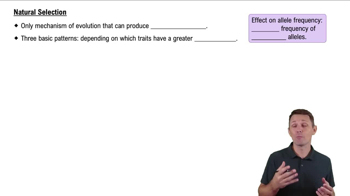
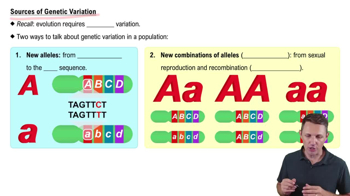
Complete this concept map describing potential causes of evolutionary change within populations.
1780
views



 Verified step by step guidance
 04:43
04:43
 02:16 04:43
Complete this concept map describing potential causes of evolutionary change within populations.
Which of the following did not influence Darwin as he synthesized the theory of evolution by natural selection?
a. Examples of artificial selection that produce large and relatively rapid changes in domesticated species.
b. Lyell's Principles of Geology, on gradual geologic changes.
c. Comparisons of fossils with living organisms.
d. Mendel's paper describing the laws of inheritance.
Natural selection is sometimes described as 'survival of the fittest.' Which of the following best measures an organism's fitness?
a. How many fertile offspring it produces
b. How strong it is when pitted against others of its species
c. Its ability to withstand environmental extremes
d. How much food it is able to make or obtain
If an allele is recessive and lethal in homozygotes before they reproduce,
a. The allele will be removed from the population by natural selection in approximately 1,000 years.
b. The allele will likely remain in the population at a low frequency because it cannot be selected against in heterozygotes.
c. The fitness of the homozygous recessive genotype is 0.
d. Both b and c are correct.
In a population with two alleles, B and b, the allele frequency of b is 0.4. B is dominant to b. What is the frequency of individuals with the dominant phenotype if the population is in Hardy-Weinberg equilibrium?
a. 0.16
b. 0.36
c. 0.48
d. 0.84
Within a few weeks of treatment with the drug 3TC, a patient's HIV population consists entirely of 3TC-resistant viruses. How can this result best be explained?
a. HIV can change its surface proteins and resist vaccines.
b. The patient must have become reinfected with a resistant virus.
c. A few drug-resistant viruses were present at the start of treatment, and natural selection increased their frequency.
d. HIV began making drug-resistant versions of its enzymes in response to the drug.