Pearson+ LogoPearson+ Logo
Ch. 13 How Populations Evolve
Taylor - Campbell Biology: Concepts & Connections 10th Edition
Taylor, Simon, Dickey, Hogan10th EditionCampbell Biology: Concepts & ConnectionsISBN: 9780136538783Not the one you use?Change textbook
Chapter 13, Problem 4

Natural selection is sometimes described as 'survival of the fittest.' Which of the following best measures an organism's fitness?
a. How many fertile offspring it produces
b. How strong it is when pitted against others of its species
c. Its ability to withstand environmental extremes
d. How much food it is able to make or obtain

Verified step by step guidance
1
Understand the concept of 'fitness' in the context of natural selection. In biology, fitness refers to an organism's ability to survive and reproduce in its environment, passing on its genes to the next generation.
Evaluate each option in terms of how it relates to the biological definition of fitness. For example, producing fertile offspring directly contributes to the continuation of an organism's genetic material.
Consider why strength (option b) alone does not necessarily measure fitness. While strength may help in survival, it does not guarantee reproduction or the passing on of genes.
Analyze option c, which refers to withstanding environmental extremes. While this may aid survival, it is not a direct measure of reproductive success, which is the key aspect of fitness.
Examine option d, which involves obtaining food. While acquiring resources is important for survival, it is not a direct measure of how many offspring an organism produces. Therefore, the best measure of fitness is the number of fertile offspring produced (option a).

Verified video answer for a similar problem:

This video solution was recommended by our tutors as helpful for the problem above.
Video duration:
55s
Was this helpful?

Key Concepts

Here are the essential concepts you must grasp in order to answer the question correctly.

Fitness in Evolutionary Biology

In evolutionary biology, fitness refers to an organism's ability to survive and reproduce in its environment. It is not solely about physical strength or survival against competitors, but rather the overall reproductive success of an organism. The more offspring an organism produces that can also reproduce, the higher its fitness.
Recommended video:
02:45
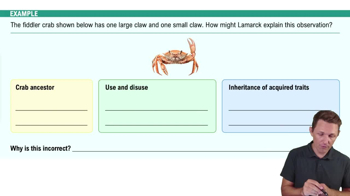
History of Evolutionary Theory Example 1

Reproductive Success

Reproductive success is a key measure of fitness, defined as the number of offspring an organism produces that survive to reproductive age. This concept emphasizes that the ultimate goal of natural selection is not just survival, but the successful passing of genes to the next generation, which is crucial for the continuation of a species.
Recommended video:
Guided course
03:12
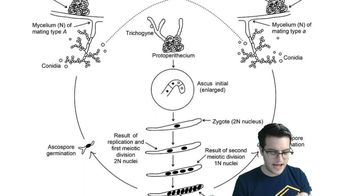
Fungi Reproduction - 3

Natural Selection

Natural selection is the process through which certain traits become more or less common in a population based on their impact on reproductive success. Organisms with advantageous traits are more likely to survive and reproduce, leading to the gradual evolution of species. This process is often summarized by the phrase 'survival of the fittest,' where 'fittest' refers to those best adapted to their environment.
Recommended video:
04:43
Natural Selection
Related Practice
Textbook Question
Summarize the key points of Darwin's theory of descent with modification, including his proposed mechanism of evolution.
1787
views
Textbook Question

Complete this concept map describing potential causes of evolutionary change within populations.

1780
views
Textbook Question

Which of the following did not influence Darwin as he synthesized the theory of evolution by natural selection?

a. Examples of artificial selection that produce large and relatively rapid changes in domesticated species.

b. Lyell's Principles of Geology, on gradual geologic changes.

c. Comparisons of fossils with living organisms.

d. Mendel's paper describing the laws of inheritance.

1687
views
Textbook Question

In an area of erratic rainfall, a biologist found that grass plants with alleles for curled leaves reproduced better in dry years, and plants with alleles for flat leaves reproduced better in wet years. This situation would tend to _________ . (Explain your answer.)

a. Cause genetic drift in the grass population.

b. Preserve genetic variation in the grass population.

c. Lead to stabilizing selection in the grass population.

d. Lead to uniformity in the grass population.

884
views
Textbook Question

If an allele is recessive and lethal in homozygotes before they reproduce,

a. The allele will be removed from the population by natural selection in approximately 1,000 years.

b. The allele will likely remain in the population at a low frequency because it cannot be selected against in heterozygotes.

c. The fitness of the homozygous recessive genotype is 0.

d. Both b and c are correct.

2242
views
Textbook Question

In a population with two alleles, B and b, the allele frequency of b is 0.4. B is dominant to b. What is the frequency of individuals with the dominant phenotype if the population is in Hardy-Weinberg equilibrium?

a. 0.16

b. 0.36

c. 0.48

d. 0.84

2037
views