Pearson+ LogoPearson+ Logo
Ch. 10 Molecular Biology of the Gene
Taylor - Campbell Biology: Concepts & Connections 10th Edition
Taylor, Simon, Dickey, Hogan10th EditionCampbell Biology: Concepts & ConnectionsISBN: 9780136538783Not the one you use?Change textbook
Chapter 10, Problem 7

Describe the process by which the information in a eukaryotic gene is transcribed and translated into a protein. Correctly use these words in your description: tRNA, amino acid, start codon, transcription, RNA splicing, exons, introns, mRNA, gene, codon, RNA polymerase, ribosome, translation, anticodon, peptide bond, stop codon.

Verified step by step guidance
1
Step 1: Transcription begins when RNA polymerase binds to a promoter region near the gene on the DNA. The DNA strands unwind, and the RNA polymerase uses one strand of DNA as a template to synthesize a pre-messenger RNA (pre-mRNA) transcript, incorporating RNA nucleotides that are complementary to the DNA template.
Step 2: RNA splicing occurs where the non-coding regions called introns are removed from the pre-mRNA. The remaining coding regions, called exons, are spliced together to form the mature mRNA. This mRNA sequence now contains only the information necessary to produce a protein.
Step 3: The mRNA is transported out of the nucleus and into the cytoplasm where translation occurs. At the ribosome, the process of translation begins with the mRNA binding to the ribosome. The ribosome reads the mRNA sequence starting at the start codon (AUG), which codes for the amino acid methionine.
Step 4: Transfer RNA (tRNA) molecules, each with an anticodon specific to its amino acid, match with the corresponding codon on the mRNA strand. Each tRNA carries a specific amino acid to the ribosome. The tRNA anticodon pairs with the mRNA codon, ensuring that the correct amino acid is added to the growing polypeptide chain.
Step 5: The ribosome moves along the mRNA, catalyzing the formation of peptide bonds between the amino acids as they are brought in by tRNAs. This process continues until a stop codon is reached on the mRNA, signaling the end of translation. The completed polypeptide chain is then released, and it folds into its functional three-dimensional protein structure.

Verified video answer for a similar problem:

This video solution was recommended by our tutors as helpful for the problem above.
Video duration:
1m
Was this helpful?

Key Concepts

Here are the essential concepts you must grasp in order to answer the question correctly.

Transcription

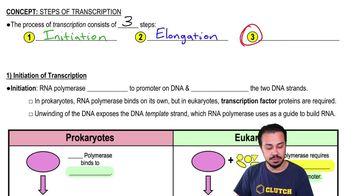
Transcription is the process by which the genetic information in a eukaryotic gene is copied into messenger RNA (mRNA). This occurs in the nucleus, where RNA polymerase binds to the DNA at the promoter region, unwinding the DNA strands and synthesizing a complementary RNA strand. During transcription, introns (non-coding regions) are removed, and exons (coding regions) are spliced together to form mature mRNA, which then exits the nucleus.
Recommended video:
Guided course
04:16
1) Initiation of Transcription

Translation

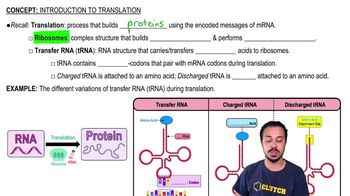
Translation is the process by which the mRNA sequence is decoded to synthesize a protein. This occurs in the ribosome, where the mRNA is read in sets of three nucleotides called codons. Each codon corresponds to a specific amino acid, which is brought to the ribosome by transfer RNA (tRNA) molecules that have complementary anticodons. The ribosome facilitates the formation of peptide bonds between amino acids, creating a polypeptide chain until a stop codon is reached, signaling the end of protein synthesis.
Recommended video:
Guided course
06:12
Introduction to Translation

Genetic Code

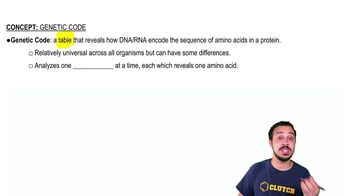
The genetic code is the set of rules that defines how the sequence of nucleotides in mRNA is translated into the sequence of amino acids in a protein. Each codon, a sequence of three nucleotides, specifies a particular amino acid or a stop signal. The start codon (AUG) initiates translation, while stop codons (UAA, UAG, UGA) terminate it. This code is universal across nearly all organisms, highlighting the commonality of life at the molecular level.
Recommended video:
Related Practice
Textbook Question

What is the name of the process that produces RNA from a DNA template?

What is the name of the process that produces a polypeptide from an RNA template?

1970
views
Textbook Question

Scientists have discovered how to put together a bacteriophage with the protein coat of phage T2 and the DNA of phage lambda. If this composite phage were allowed to infect a bacterium, the phages produced in the host cell would have _________. (Explain your answer.)

a. The protein of T2 and the DNA of lambda

b. The protein of lambda and the DNA of T2

c. The protein and DNA of T2

d. The protein and DNA of lambda

1683
views
Textbook Question

A geneticist found that a particular mutation had no effect on the polypeptide encoded by a gene. This mutation probably involved

a. Deletion of one nucleotide

b. Alteration of the start codon

c. Insertion of one nucleotide

d. Substitution of one nucleotide

1799
views
Textbook Question

The nucleotide sequence of a DNA codon is GTA. A messenger RNA molecule with a complementary codon is transcribed from the DNA. In the process of protein synthesis, a transfer RNA pairs with the mRNA codon. What is the nucleotide sequence of the tRNA anticodon?

a. CAT

b. CUT

c. GUA

d. CAU

1798
views
Textbook Question
A cell containing a single chromosome is placed in a medium containing radioactive phosphate so that any new DNA strands formed by DNA replication will be radioactive. The cell replicates its DNA and divides. Then the daughter cells (still in the radioactive medium) replicate their DNA and divide, and a total of four cells are present. Sketch the DNA molecules in all four cells, showing a normal (nonradioactive) DNA strand as a solid line and a radioactive DNA strand as a dashed line.
896
views
Textbook Question
The base sequence of the gene coding for a short polypeptide is CTACGCTAGGCGATTGACT. What would be the base sequence of the mRNA transcribed from this gene? Using the genetic code, give the amino acid sequence of the polypeptide translated from this mRNA. (Hint: What is the start codon?)
1909
views