Pearson+ LogoPearson+ Logo
Ch. 3 The Molecules of Cells
Taylor - Campbell Biology: Concepts & Connections 10th Edition
Taylor, Simon, Dickey, Hogan10th EditionCampbell Biology: Concepts & ConnectionsISBN: 9780136538783Not the one you use?Change textbook
Chapter 3, Problem 12

Sucrose is broken down in your intestine to the monosaccharides glucose and fructose, which are then absorbed into your blood. What is the name of this type of reaction?
Using this diagram of sucrose, show how this would occur.
Chemical structure of sucrose, illustrating its breakdown into glucose and fructose.

Verified step by step guidance
1
Step 1: Identify the type of reaction. The breakdown of sucrose into glucose and fructose is a hydrolysis reaction. Hydrolysis involves the addition of water (H₂O) to break a covalent bond, specifically the glycosidic bond in sucrose.
Step 2: Locate the glycosidic bond in the sucrose molecule. In the diagram, the glycosidic bond is the oxygen atom (O) connecting the two monosaccharides: glucose and fructose.
Step 3: Explain the role of water in the reaction. During hydrolysis, a water molecule is split into a hydrogen ion (H⁺) and a hydroxide ion (OH⁻). The H⁺ attaches to one monosaccharide (glucose), and the OH⁻ attaches to the other monosaccharide (fructose), breaking the glycosidic bond.
Step 4: Describe the enzyme involved. In the intestine, the enzyme sucrase catalyzes this hydrolysis reaction, ensuring the efficient breakdown of sucrose into glucose and fructose.
Step 5: Show the result of the reaction. After hydrolysis, the sucrose molecule is split into two monosaccharides: glucose and fructose. These monosaccharides are absorbed into the bloodstream for energy production or storage.

Verified video answer for a similar problem:

This video solution was recommended by our tutors as helpful for the problem above.
Video duration:
50s
Was this helpful?

Key Concepts

Here are the essential concepts you must grasp in order to answer the question correctly.

Hydrolysis

Hydrolysis is a chemical reaction in which water is used to break down a compound. In the context of sucrose, hydrolysis involves the addition of a water molecule to cleave the glycosidic bond between glucose and fructose, resulting in the formation of these two monosaccharides. This reaction is essential for digestion, allowing complex carbohydrates to be converted into simpler sugars that can be absorbed by the body.
Recommended video:
Guided course
04:57
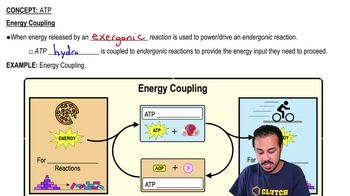
Energy Coupling

Monosaccharides

Monosaccharides are the simplest form of carbohydrates, consisting of single sugar molecules such as glucose and fructose. They serve as the building blocks for more complex carbohydrates and are crucial for energy production in living organisms. After the hydrolysis of sucrose, glucose and fructose are absorbed into the bloodstream, where they can be utilized by cells for energy.
Recommended video:
Guided course
03:08
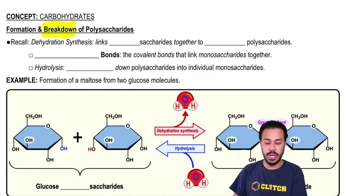
Formation & Breakdown of Polysaccharides

Enzymatic Action

Enzymatic action refers to the role of enzymes in facilitating biochemical reactions, including the breakdown of sucrose. In the intestine, the enzyme sucrase catalyzes the hydrolysis of sucrose into glucose and fructose. This process is vital for efficient digestion and nutrient absorption, as enzymes lower the activation energy required for reactions, allowing them to occur more rapidly and under physiological conditions.
Recommended video:
Guided course
09:55
Action Potential