Pearson+ LogoPearson+ Logo
Ch. 3 The Molecules of Cells
Taylor - Campbell Biology: Concepts & Connections 10th Edition
Taylor, Simon, Dickey, Hogan10th EditionCampbell Biology: Concepts & ConnectionsISBN: 9780136538783Not the one you use?Change textbook
Chapter 3, Problem 15

The diversity of life is staggering. Yet the molecular logic of life is simple and elegant: small molecules common to all organisms are ordered into unique macromolecules. Explain why carbon is central to this diversity of organic molecules.
How do carbon skeletons, chemical groups, monomers, and polymers relate to this molecular logic of life?
3D model of a carbon atom bonded to four hydrogen atoms, illustrating carbon's role in organic molecules.

Verified step by step guidance
1
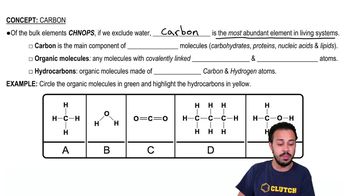
Carbon is central to the diversity of organic molecules because it has four valence electrons, allowing it to form up to four covalent bonds with other atoms. This property enables carbon to act as a versatile backbone for complex molecules.
Carbon skeletons can vary in length, branching, and shape (e.g., straight chains, branched chains, or rings). These variations provide the structural framework for organic molecules and contribute to the diversity of life.
Chemical groups, such as hydroxyl (-OH), carboxyl (-COOH), amino (-NH2), and phosphate (-PO4), can attach to carbon skeletons. These groups influence the chemical properties and reactivity of organic molecules, enabling specific biological functions.
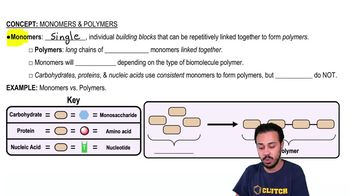
Monomers are small molecules that serve as building blocks for larger macromolecules. For example, glucose is a monomer for polysaccharides, and amino acids are monomers for proteins. Carbon's ability to form stable bonds allows these monomers to link together through processes like dehydration synthesis.
Polymers are large macromolecules formed by the repeated linking of monomers. Examples include proteins, nucleic acids, and polysaccharides. The molecular logic of life is based on the assembly of these polymers, which are unique to each organism but built from common monomers, demonstrating the elegant simplicity of life's molecular diversity.

Verified video answer for a similar problem:

This video solution was recommended by our tutors as helpful for the problem above.
Video duration:
54s
Was this helpful?

Key Concepts

Here are the essential concepts you must grasp in order to answer the question correctly.

Carbon's Versatility

Carbon is unique due to its ability to form four covalent bonds with other atoms, allowing it to create a vast array of complex molecules. This tetravalency enables carbon to bond with various elements, including hydrogen, oxygen, and nitrogen, leading to the formation of diverse organic compounds essential for life.
Recommended video:

Carbon Skeletons

Carbon skeletons refer to the chain or ring structures formed by carbon atoms in organic molecules. These skeletons can vary in length and shape, influencing the properties and functions of the molecules. The arrangement of carbon skeletons is fundamental in determining the characteristics of different organic compounds.
Recommended video:

Monomers and Polymers

Monomers are the basic building blocks of larger molecules, known as polymers. In biological systems, monomers like amino acids, nucleotides, and simple sugars combine through covalent bonds to form complex macromolecules such as proteins, nucleic acids, and carbohydrates. This process of polymerization is crucial for the structure and function of biological macromolecules.
Recommended video:
Guided course
03:42
Monomers & Polymers