Pearson+ LogoPearson+ Logo
Ch. 3 The Molecules of Cells
Taylor - Campbell Biology: Concepts & Connections 10th Edition
Taylor, Simon, Dickey, Hogan10th EditionCampbell Biology: Concepts & ConnectionsISBN: 9780136538783Not the one you use?Change textbook
Chapter 3, Problem 16

How can a cell make many different kinds of proteins out of only 20 amino acids?
Of the myriad possibilities, how does the cell 'know' which proteins to make?

Verified step by step guidance
1
Understand that proteins are made up of chains of amino acids, and the sequence of these amino acids determines the protein's structure and function. The 20 amino acids can be arranged in countless combinations to create a vast diversity of proteins.
Recognize that the instructions for making proteins are encoded in the cell's DNA. Genes, which are specific sequences of DNA, contain the information needed to assemble amino acids in the correct order to form a protein.
Learn about the process of transcription, where a gene's DNA sequence is copied into messenger RNA (mRNA). This mRNA serves as a temporary template that carries the genetic instructions from the nucleus to the ribosome, where proteins are synthesized.
Explore the process of translation, where the ribosome reads the mRNA sequence in sets of three nucleotides called codons. Each codon corresponds to a specific amino acid, and transfer RNA (tRNA) molecules bring the appropriate amino acids to the ribosome based on the codon sequence.
Understand that the cell 'knows' which proteins to make based on regulatory mechanisms. These include signals from the environment, cell-to-cell communication, and regulatory proteins that control gene expression, ensuring that the right proteins are produced at the right time and in the right amounts.

Verified video answer for a similar problem:

This video solution was recommended by our tutors as helpful for the problem above.
Video duration:
1m
Was this helpful?

Key Concepts

Here are the essential concepts you must grasp in order to answer the question correctly.

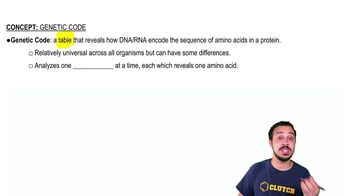
Genetic Code

The genetic code is a set of rules that defines how the sequence of nucleotides in DNA corresponds to the sequence of amino acids in proteins. It consists of codons, which are three-nucleotide sequences that specify particular amino acids. This code allows cells to translate genetic information into functional proteins, enabling the diversity of protein structures and functions from a limited set of amino acids.
Recommended video:

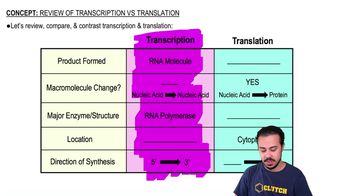
Transcription and Translation

Transcription is the process by which the information in a gene's DNA is copied into messenger RNA (mRNA). This mRNA then undergoes translation, where ribosomes read the mRNA sequence and assemble the corresponding amino acids into a polypeptide chain, forming a protein. These processes are crucial for determining which proteins are synthesized in response to cellular needs and environmental signals.
Recommended video:
Guided course
04:07
Review of Transcription vs. Translation

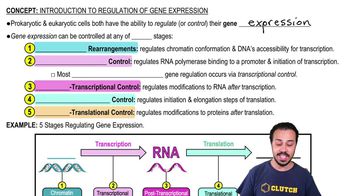
Gene Regulation

Gene regulation refers to the mechanisms that control the expression of genes, determining when and how much of a protein is produced. This regulation can occur at various levels, including transcriptional, post-transcriptional, and translational control. By responding to internal and external cues, cells can selectively express certain genes, allowing them to produce specific proteins as needed for various functions and adaptations.
Recommended video:
Guided course
06:40
Introduction to Regulation of Gene Expression