Pearson+ LogoPearson+ Logo
Ch. 3 The Molecules of Cells
Taylor - Campbell Biology: Concepts & Connections 10th Edition
Taylor, Simon, Dickey, Hogan10th EditionCampbell Biology: Concepts & ConnectionsISBN: 9780136538783Not the one you use?Change textbook
Chapter 3, Problem 14

What are the two types of secondary structures found in polypeptides, and what maintains them?
What stabilizes the tertiary structure of a polypeptide?

Verified step by step guidance
1
The two types of secondary structures found in polypeptides are the alpha-helix (α-helix) and the beta-pleated sheet (β-sheet). These structures are formed by the folding of the polypeptide chain in specific patterns.
The secondary structures are maintained by hydrogen bonds. In the α-helix, hydrogen bonds form between the carbonyl oxygen (C=O) of one amino acid and the amide hydrogen (N-H) of another amino acid four residues away. In the β-sheet, hydrogen bonds form between the carbonyl oxygen and amide hydrogen of amino acids in adjacent strands.
The tertiary structure of a polypeptide refers to its three-dimensional shape, which is formed by the folding and interactions of the secondary structures.
The tertiary structure is stabilized by various interactions, including hydrogen bonds, ionic bonds, hydrophobic interactions, and disulfide bridges. Disulfide bridges are covalent bonds formed between the sulfur atoms of two cysteine residues.
These interactions collectively contribute to the overall stability and functionality of the protein, allowing it to perform its biological role effectively.

Verified video answer for a similar problem:

This video solution was recommended by our tutors as helpful for the problem above.
Video duration:
54s
Was this helpful?

Key Concepts

Here are the essential concepts you must grasp in order to answer the question correctly.

Secondary Structure of Proteins

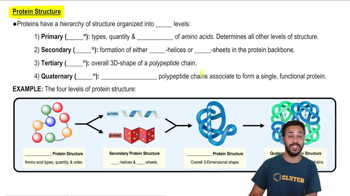
The secondary structure of proteins refers to the local folded structures that form within a polypeptide due to hydrogen bonding between the backbone atoms. The two most common types are alpha helices, which are coiled structures, and beta sheets, which are flat, sheet-like arrangements. These structures are crucial for the overall shape and function of proteins.
Recommended video:
Guided course
08:02
Protein Structure

Hydrogen Bonds

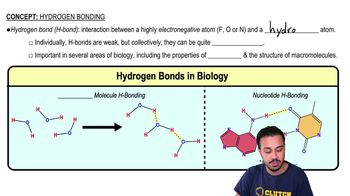
Hydrogen bonds are weak interactions that occur between a hydrogen atom covalently bonded to an electronegative atom and another electronegative atom. In the context of protein secondary structures, these bonds stabilize the alpha helices and beta sheets by forming between the carbonyl oxygen of one amino acid and the amide hydrogen of another. This interaction is essential for maintaining the integrity of the protein's structure.
Recommended video:
Guided course
05:03
Hydrogen Bonding

Tertiary Structure of Proteins

The tertiary structure of a protein is its overall three-dimensional shape, formed by the interactions between the side chains of the amino acids. This structure is stabilized by various forces, including hydrogen bonds, ionic bonds, hydrophobic interactions, and disulfide bridges. The tertiary structure is critical for the protein's functionality, as it determines how the protein interacts with other molecules.
Recommended video:
Guided course
08:02
Protein Structure