Pearson+ LogoPearson+ Logo
Ch. 14 The Origin of Species
Taylor - Campbell Biology: Concepts & Connections 10th Edition
Taylor, Simon, Dickey, Hogan10th EditionCampbell Biology: Concepts & ConnectionsISBN: 9780136538783Not the one you use?Change textbook
Chapter 14, Problem 12

Which of the following factors would not contribute to allopatric speciation?
a. A population becomes geographically isolated from the parent population.
b. The separated population is small, and genetic drift occurs.
c. The isolated population is exposed to different selection pressures than the parent population.
d. Gene flow between the two populations continues to occur.

Verified step by step guidance
1
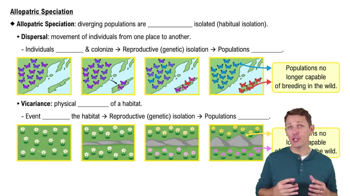
Understand the concept of allopatric speciation: Allopatric speciation occurs when a population is geographically separated into two or more groups, leading to the evolution of new species due to genetic divergence. Key factors include geographic isolation, genetic drift, and differing selection pressures.
Analyze each option to determine its relevance to allopatric speciation: For example, geographic isolation (option a) is a fundamental requirement for allopatric speciation, as it prevents gene flow between populations.
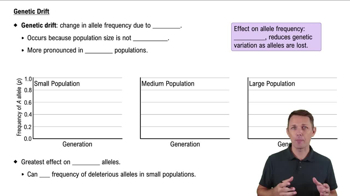
Consider the role of genetic drift (option b): In small populations, genetic drift can lead to significant changes in allele frequencies, contributing to divergence and speciation.
Evaluate the impact of differing selection pressures (option c): When populations are exposed to different environmental conditions, natural selection can drive adaptations that further differentiate the populations.
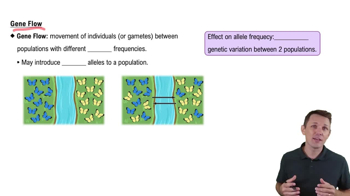
Identify the factor that would not contribute to allopatric speciation (option d): Gene flow between populations counteracts the genetic divergence necessary for speciation, as it allows the exchange of alleles and reduces differences between the groups.

Verified video answer for a similar problem:

This video solution was recommended by our tutors as helpful for the problem above.
Video duration:
1m
Was this helpful?

Key Concepts

Here are the essential concepts you must grasp in order to answer the question correctly.

Allopatric Speciation

Allopatric speciation is a biological process where new species arise due to geographic isolation. When a population is divided by physical barriers, such as mountains or rivers, the separated groups evolve independently. Over time, genetic differences accumulate, potentially leading to reproductive isolation and the emergence of distinct species.
Recommended video:
03:53
Allopatric Speciation

Genetic Drift

Genetic drift is a mechanism of evolution that occurs due to random changes in allele frequencies within a population, particularly in small populations. This can lead to significant changes over generations, affecting genetic diversity and potentially contributing to speciation. In the context of allopatric speciation, genetic drift can enhance divergence between isolated populations.
Recommended video:
05:06
Genetic Drift

Gene Flow

Gene flow refers to the transfer of genetic material between populations through migration and reproduction. It acts to maintain genetic similarity between populations, counteracting the effects of speciation. In allopatric speciation, ongoing gene flow between isolated populations can prevent the development of distinct species, making it a critical factor in understanding the speciation process.
Recommended video:
01:43
Gene Flow