Pearson+ LogoPearson+ Logo
Ch. 14 The Origin of Species
Taylor - Campbell Biology: Concepts & Connections 10th Edition
Taylor, Simon, Dickey, Hogan10th EditionCampbell Biology: Concepts & ConnectionsISBN: 9780136538783Not the one you use?Change textbook
Chapter 14, Problem 11

When hybrids produced in a hybrid zone can breed with each other and with both parent species, and they survive and reproduce as well as members of the parent species, one would predict that
a. The hybrid zone would be stable.
b. Sympatric speciation would occur.
c. Reinforcement of reproductive barriers would keep the parent species separate.
d. Reproductive barriers would lessen and the two parent species would fuse.

Verified step by step guidance
1
Understand the context of the problem: A hybrid zone is a region where members of different species meet and mate, producing offspring of mixed ancestry (hybrids). The problem focuses on the outcome when hybrids are viable, fertile, and can reproduce as successfully as the parent species.
Analyze the reproductive success of hybrids: If hybrids can breed with each other and with both parent species, and their survival and reproduction rates are comparable to those of the parent species, this suggests that there are no strong reproductive barriers preventing gene flow between the species.
Consider the implications for reproductive barriers: Since hybrids are equally viable and fertile, there is no selective pressure to reinforce reproductive barriers. Instead, the lack of barriers allows for increased gene flow between the parent species and hybrids.
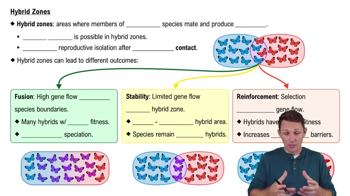
Predict the long-term outcome: Over time, the continued gene flow between the parent species and hybrids would likely reduce the genetic distinctions between the parent species. This process is known as fusion, where the two species merge into a single population.
Conclude the correct prediction: Based on the analysis, the correct prediction is that reproductive barriers would lessen, and the two parent species would fuse. This corresponds to option d.

Verified video answer for a similar problem:

This video solution was recommended by our tutors as helpful for the problem above.
Video duration:
2m
Was this helpful?

Key Concepts

Here are the essential concepts you must grasp in order to answer the question correctly.

Hybrid Zone

A hybrid zone is a geographic area where two distinct species meet and interbreed, producing hybrid offspring. The dynamics within a hybrid zone can provide insights into the processes of speciation and the stability of species boundaries. The interactions between hybrids and parent species can influence evolutionary outcomes, such as the reinforcement of reproductive barriers or the potential fusion of species.
Recommended video:
04:38
Hybrid Zones

Reproductive Barriers

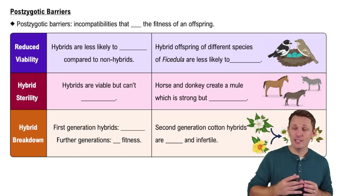
Reproductive barriers are mechanisms that prevent species from interbreeding and producing viable offspring. These barriers can be prezygotic (preventing mating or fertilization) or postzygotic (affecting the viability or fertility of hybrid offspring). Understanding these barriers is crucial for predicting the outcomes of hybridization, including whether species will remain distinct or merge over time.
Recommended video:
03:28
Postzygotic Barriers

Sympatric Speciation

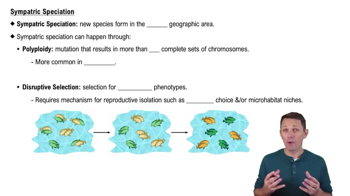
Sympatric speciation occurs when new species arise from a single ancestral species while inhabiting the same geographic region. This process often involves mechanisms such as polyploidy, sexual selection, or habitat differentiation. In the context of hybrid zones, sympatric speciation can be influenced by the interactions between hybrids and parent species, potentially leading to the development of new reproductive barriers.
Recommended video:
03:57
Sympatric Speciation