Pearson+ LogoPearson+ Logo
Ch. 17 The Evolution of Plant and Fungal Diversity
Taylor - Campbell Biology: Concepts & Connections 10th Edition
Taylor, Simon, Dickey, Hogan10th EditionCampbell Biology: Concepts & ConnectionsISBN: 9780136538783Not the one you use?Change textbook
Chapter 17, Problem 10

Compare a seed plant with an alga in terms of adaptations for life on land versus life in the water.

Verified step by step guidance
1
Identify the key differences in the habitats of seed plants and algae. Seed plants are primarily terrestrial and have adaptations to live on land, while algae are mostly aquatic and adapted to living in water environments.
Discuss the structural adaptations of seed plants for life on land. This includes features like roots for anchoring and water absorption, stems for support and transport, and leaves for photosynthesis. Also, mention the cuticle that covers aerial parts to reduce water loss.
Explain the reproductive adaptations of seed plants that suit terrestrial life. Highlight the development of seeds which protect the embryo and provide it with nutrients, and the presence of pollen which facilitates reproduction without the need for water.
Describe the adaptations of algae to aquatic life. Focus on aspects like buoyancy adaptations, such as air bladders that help them float to access light for photosynthesis, and the presence of flagella in some algae for movement in water.
Compare how both organisms manage gas exchange and nutrient acquisition in their respective environments. Seed plants use stomata for gas exchange and have roots to absorb nutrients from the soil, whereas algae absorb nutrients and gases directly from the water through their entire surface.

Verified video answer for a similar problem:

This video solution was recommended by our tutors as helpful for the problem above.
Video duration:
1m
Was this helpful?

Key Concepts

Here are the essential concepts you must grasp in order to answer the question correctly.

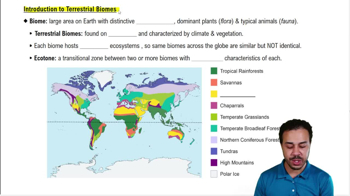
Adaptations for Terrestrial Life

Seed plants have developed various adaptations for life on land, such as a waxy cuticle to prevent water loss, stomata for gas exchange, and deep root systems for anchorage and nutrient absorption. These features enable them to thrive in terrestrial environments where water availability can be limited.
Recommended video:
Guided course
01:55
Introduction to Terrestrial Biomes

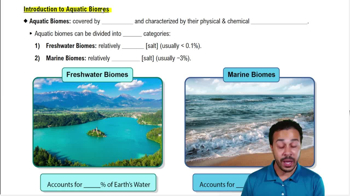
Aquatic Adaptations

Algae, primarily aquatic organisms, possess adaptations suited for life in water, such as buoyancy provided by their structure, which allows them to remain suspended in water. They also have a large surface area for efficient nutrient absorption and gas exchange directly from the surrounding water, which is abundant in their habitat.
Recommended video:
Guided course
01:38
Introduction to Aquatic Biomes

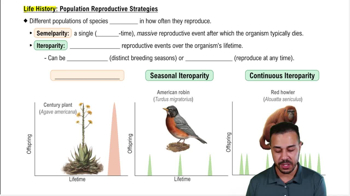
Reproductive Strategies

Seed plants typically reproduce through seeds, which provide protection and nourishment to the developing embryo, allowing for survival in diverse terrestrial environments. In contrast, algae often reproduce via spores or gametes that are released into the water, relying on water for fertilization and dispersal, which is essential for their aquatic lifestyle.
Recommended video:
Guided course
02:51
Life History: Population Reproductive Strategies