
Pearson+ LogoPearson+ Logo
Ch. 4 A Tour of the Cell
Taylor - Campbell Biology: Concepts & Connections 10th Edition
Taylor, Simon, Dickey, Hogan10th EditionCampbell Biology: Concepts & ConnectionsISBN: 9780136538783Not the one you use?Change textbook
Chapter 4, Problem 12

In what ways do the internal membranes of a eukaryotic cell contribute to the functioning of the cell?

Verified step by step guidance
1
Identify the various internal membranes within a eukaryotic cell, such as the nuclear envelope, endoplasmic reticulum, Golgi apparatus, lysosomes, and mitochondria.
Explain how the nuclear envelope, composed of two lipid bilayers, surrounds the nucleus and regulates the flow of molecules in and out of the nucleus, thus protecting the DNA and maintaining the cell's genetic control center.
Discuss the role of the endoplasmic reticulum (ER) in protein and lipid synthesis. Highlight the distinction between the rough ER, which is studded with ribosomes and synthesizes proteins, and the smooth ER, which is involved in lipid synthesis and detoxification processes.
Describe how the Golgi apparatus functions as a sorting and packaging center, modifying proteins and lipids received from the ER and directing them to their appropriate destinations inside or outside the cell.
Examine the roles of mitochondria and lysosomes, where mitochondria are responsible for ATP production through cellular respiration, providing energy for the cell, and lysosomes contain enzymes that break down macromolecules, disposing of the cell's waste and recycling cellular materials.

Verified video answer for a similar problem:

This video solution was recommended by our tutors as helpful for the problem above.
Video duration:
2m
Was this helpful?

Key Concepts

Here are the essential concepts you must grasp in order to answer the question correctly.

Eukaryotic Cell Structure

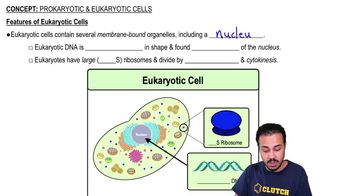
Eukaryotic cells are characterized by their complex structure, which includes membrane-bound organelles such as the nucleus, mitochondria, and endoplasmic reticulum. These organelles are essential for compartmentalizing cellular processes, allowing for specialized functions and increased efficiency in metabolism and energy production.
Recommended video:
Guided course
04:17
Features of Eukaryotic Cells

Membrane Functionality

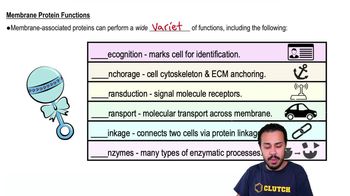
The internal membranes of eukaryotic cells serve multiple functions, including creating distinct environments for biochemical reactions, regulating the transport of molecules, and facilitating communication between organelles. These membranes are selectively permeable, allowing only certain substances to pass through, which is crucial for maintaining homeostasis within the cell.
Recommended video:
Guided course
03:54
Membrane Protein Functions

Endomembrane System

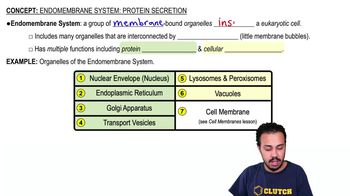
The endomembrane system is a network of membranes that includes the nuclear envelope, endoplasmic reticulum, Golgi apparatus, lysosomes, and vesicles. This system is vital for the synthesis, modification, and transport of proteins and lipids, ensuring that cellular components are properly processed and delivered to their destinations, thus supporting overall cell function.
Recommended video:
Guided course
04:13
Endomembrane System: Protein Secretion
Related Practice
Textbook Question

In which cell would you find the most smooth ER?

a. Pancreatic cell that secretes digestive enzymes

b. Ovarian cell that produces estrogen (a steroid hormone)

c. Muscle cell in the thigh of a long-distance runner

d. White blood cell that engulfs bacteria

1850
views
Textbook Question

In which cell would you find the most rough ER?

a. Pancreatic cell that secretes digestive enzymes

b. Ovarian cell that produces estrogen (a steroid hormone)

c. Muscle cell in the thigh of a long-distance runner

d. White blood cell that engulfs bacteria

2222
views
Textbook Question

In which cell would you find the most mitochondria?

a. Pancreatic cell that secretes digestive enzymes

b. Ovarian cell that produces estrogen (a steroid hormone)

c. Muscle cell in the thigh of a long-distance runner

d. White blood cell that engulfs bacteria

1624
views
Textbook Question

Is this statement true or false?

'Animal cells have mitochondria; plant cells have chloroplasts.'

Explain your answer, and describe the functions of these organelles.

2276
views
Textbook Question
Describe the structure of the plasma membrane of an animal cell. What would be found directly inside and outside the membrane?
2300
views
Textbook Question

Imagine a spherical cell with a radius of 10 μm. What is the cell's surface area in μm²?

Its volume, in μm³? (Note: For a sphere of radius r, surface area = 4πr² and volume = 4/3πr³.). Remember that the value of π is 3.14.)

What is the ratio of surface area to volume for this cell? Now do the same calculations for a second cell, this one with a radius of 20 μm. Compare the surface-to-volume ratios of the two cells.

How is this comparison significant to the functioning of cells?

2512
views