
Pearson+ LogoPearson+ Logo
Ch. 4 A Tour of the Cell
Taylor - Campbell Biology: Concepts & Connections 10th Edition
Taylor, Simon, Dickey, Hogan10th EditionCampbell Biology: Concepts & ConnectionsISBN: 9780136538783Not the one you use?Change textbook
Chapter 4, Problem 13

Is this statement true or false?
'Animal cells have mitochondria; plant cells have chloroplasts.'
Explain your answer, and describe the functions of these organelles.

Verified step by step guidance
1
Step 1: Begin by analyzing the statement 'Animal cells have mitochondria; plant cells have chloroplasts.' Determine whether it is accurate or if it oversimplifies the presence of organelles in these cell types.
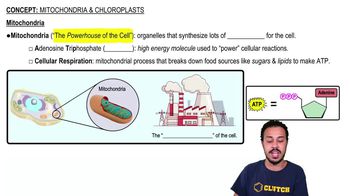
Step 2: Explain that both animal and plant cells have mitochondria, as mitochondria are essential for cellular respiration, which provides energy in the form of ATP for various cellular processes.
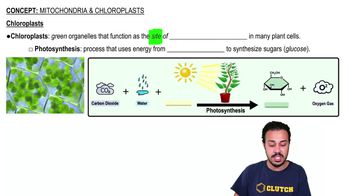
Step 3: Clarify that plant cells also have chloroplasts, which are specialized organelles responsible for photosynthesis. Photosynthesis converts light energy into chemical energy stored in glucose, which is unique to plant cells and some protists.
Step 4: Describe the functions of mitochondria and chloroplasts. Mitochondria are often referred to as the 'powerhouses' of the cell because they generate ATP through oxidative phosphorylation. Chloroplasts, on the other hand, contain chlorophyll and other pigments that capture light energy to drive the photosynthetic process.
Step 5: Conclude by stating that the statement is partially true but incomplete. While it correctly identifies that animal cells have mitochondria and plant cells have chloroplasts, it fails to mention that plant cells also have mitochondria, making the statement misleading.

Verified video answer for a similar problem:

This video solution was recommended by our tutors as helpful for the problem above.
Video duration:
1m
Was this helpful?

Key Concepts

Here are the essential concepts you must grasp in order to answer the question correctly.

Mitochondria

Mitochondria are known as the powerhouses of the cell, responsible for producing adenosine triphosphate (ATP) through cellular respiration. This process converts biochemical energy from nutrients into ATP, which is used to power various cellular activities. Mitochondria are found in both animal and plant cells, highlighting their essential role in energy metabolism.
Recommended video:

Chloroplasts

Chloroplasts are organelles found exclusively in plant cells and some protists, responsible for photosynthesis. They contain chlorophyll, the pigment that captures light energy, converting it into chemical energy stored in glucose. This process not only provides energy for the plant but also produces oxygen as a byproduct, which is vital for aerobic organisms.
Recommended video:

Cellular Organelles

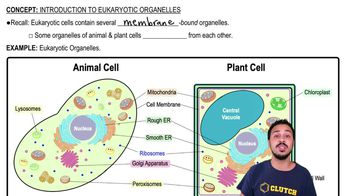
Cellular organelles are specialized structures within cells that perform distinct functions necessary for the cell's survival and operation. In eukaryotic cells, such as those of animals and plants, organelles like mitochondria and chloroplasts play critical roles in energy production and metabolism. Understanding these organelles is essential for grasping how cells maintain homeostasis and support life processes.
Recommended video:
Guided course
03:45
Introduction to Eukaryotic Organelles
Related Practice