Pearson+ LogoPearson+ Logo
Ch. 4 A Tour of the Cell
Taylor - Campbell Biology: Concepts & Connections 10th Edition
Taylor, Simon, Dickey, Hogan10th EditionCampbell Biology: Concepts & ConnectionsISBN: 9780136538783Not the one you use?Change textbook
Chapter 4, Problem 10

In which cell would you find the most rough ER?
a. Pancreatic cell that secretes digestive enzymes
b. Ovarian cell that produces estrogen (a steroid hormone)
c. Muscle cell in the thigh of a long-distance runner
d. White blood cell that engulfs bacteria

Verified step by step guidance
1
Understand the function of rough endoplasmic reticulum (rough ER): The rough ER is involved in the synthesis and processing of proteins, particularly those that are secreted, inserted into membranes, or sent to lysosomes.
Analyze the role of each cell type in the options: a) Pancreatic cells secrete digestive enzymes, which are proteins. b) Ovarian cells produce estrogen, a steroid hormone, which is synthesized in the smooth ER, not the rough ER. c) Muscle cells are involved in contraction and rely on structural proteins but do not specialize in secreting proteins. d) White blood cells engulf bacteria and rely on lysosomes for digestion, but they do not specialize in protein secretion.
Focus on the cell type that synthesizes and secretes the most proteins: Pancreatic cells produce and secrete large amounts of digestive enzymes, which are proteins, requiring extensive rough ER for their production.
Eliminate options that do not align with the function of rough ER: Ovarian cells (b) rely on smooth ER for steroid hormone production, muscle cells (c) do not specialize in protein secretion, and white blood cells (d) focus on engulfing and digesting bacteria rather than secreting proteins.
Conclude that the pancreatic cell (a) is the most likely to have the most rough ER due to its role in producing and secreting digestive enzymes, which are protein-based.

Verified video answer for a similar problem:

This video solution was recommended by our tutors as helpful for the problem above.
Video duration:
2m
Was this helpful?

Key Concepts

Here are the essential concepts you must grasp in order to answer the question correctly.

Rough Endoplasmic Reticulum (Rough ER)

The rough endoplasmic reticulum (Rough ER) is a type of endoplasmic reticulum that is studded with ribosomes on its cytoplasmic surface, giving it a 'rough' appearance. It plays a crucial role in the synthesis and processing of proteins, particularly those that are secreted from the cell or incorporated into the cell membrane. Cells that produce large amounts of proteins typically have extensive rough ER.
Recommended video:
Guided course
06:07
Endoplasmic Reticulum

Pancreatic Cells

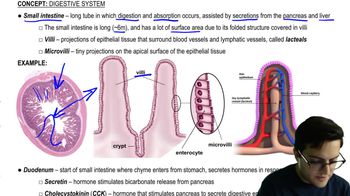
Pancreatic cells, specifically the acinar cells, are responsible for producing digestive enzymes such as amylase, lipase, and proteases. These enzymes are synthesized in the rough ER and then transported to the Golgi apparatus for further processing and secretion. Due to their function in enzyme production, pancreatic cells have a high concentration of rough ER.
Recommended video:
Guided course
06:15
Small Intestine and Pancreas

Cellular Function and Protein Synthesis

Different cell types have specialized functions that dictate their structure and organelle composition. For instance, cells involved in hormone production, like ovarian cells, primarily utilize smooth ER for lipid synthesis, while muscle cells focus on energy production and contraction. Understanding the relationship between a cell's function and its organelle composition is essential for identifying which cell type would have the most rough ER.
Recommended video:
Guided course
03:54
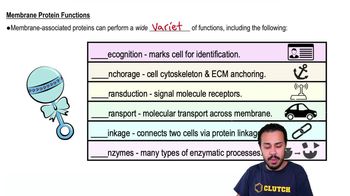
Membrane Protein Functions