
Pearson+ LogoPearson+ Logo
Ch. 4 A Tour of the Cell
Taylor - Campbell Biology: Concepts & Connections 10th Edition
Taylor, Simon, Dickey, Hogan10th EditionCampbell Biology: Concepts & ConnectionsISBN: 9780136538783Not the one you use?Change textbook
Chapter 4, Problem 6

What four cellular components are shared by prokaryotic and eukaryotic cells?

Verified step by step guidance
1
Identify the basic structure of both prokaryotic and eukaryotic cells to find common components.
Recognize that both cell types have a plasma membrane that surrounds the cell, providing a barrier and controlling the entry and exit of substances.
Note that both prokaryotic and eukaryotic cells contain cytoplasm, a jelly-like substance where various cellular processes occur.
Acknowledge that ribosomes, which are responsible for protein synthesis, are present in both types of cells.
Consider that both cell types contain genetic material (DNA) which is essential for the cell's functions and reproduction.

Verified video answer for a similar problem:

This video solution was recommended by our tutors as helpful for the problem above.
Video duration:
1m
Was this helpful?

Key Concepts

Here are the essential concepts you must grasp in order to answer the question correctly.

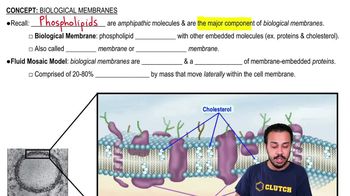
Cell Membrane

The cell membrane is a vital structure that surrounds all cells, providing a barrier that separates the internal environment from the external surroundings. It is composed of a phospholipid bilayer with embedded proteins, allowing selective permeability for ions and molecules, which is essential for maintaining homeostasis.
Recommended video:
Guided course
06:04
Biological Membranes

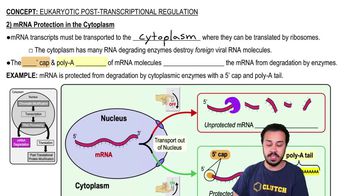
Cytoplasm

Cytoplasm is the gel-like substance within the cell membrane that contains all cellular components, excluding the nucleus in eukaryotic cells. It is the site of many metabolic processes and provides a medium for the movement of organelles and molecules, facilitating cellular functions.
Recommended video:
Guided course
04:08
2) mRNA Protection in the Cytoplasm

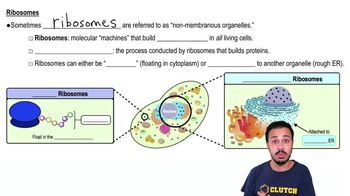
Ribosomes

Ribosomes are the molecular machines responsible for protein synthesis in all living cells. They can be found freely floating in the cytoplasm or attached to the endoplasmic reticulum in eukaryotic cells. Ribosomes translate messenger RNA (mRNA) into polypeptide chains, which fold into functional proteins.
Recommended video:
Related Practice
Textbook Question

The cells of an ant and an elephant are, on average, the same small size; an elephant just has more of them. What is the main advantage of small cell size? (Explain your reasoning.)

a. A small cell has a larger plasma membrane surface area than does a large cell.

b. Small cells can better take up sufficient nutrients and oxygen to service their cell volume.

c. It takes less energy to make an organism out of small cells.

d. Small cells require less oxygen than do large cells.

1584
views
Textbook Question

Which of the following clues would tell you whether a cell is prokaryotic or eukaryotic?

a. The presence or absence of a rigid cell wall

b. Whether or not the cell is partitioned by internal membranes

c. The presence or absence of ribosomes

d. Both b and c are important clues

1888
views
Textbook Question

Which of the following is one of the major components of the plasma membrane of a plant cell?

a. Phospholipids

b. Cellulose fibers

c. Collagen fibers

d. Pectins

1546
views
Textbook Question
Describe two different ways in which cilia can function in organisms.
1810
views
Textbook Question

In which cell would you find the most lysosomes?

a. Pancreatic cell that secretes digestive enzymes

b. Ovarian cell that produces estrogen (a steroid hormone)

c. Muscle cell in the thigh of a long-distance runner

d. White blood cell that engulfs bacteria

2001
views
Textbook Question

In which cell would you find the most smooth ER?

a. Pancreatic cell that secretes digestive enzymes

b. Ovarian cell that produces estrogen (a steroid hormone)

c. Muscle cell in the thigh of a long-distance runner

d. White blood cell that engulfs bacteria

1850
views