
Pearson+ LogoPearson+ Logo
Ch. 5 The Working Cell
Taylor - Campbell Biology: Concepts & Connections 10th Edition
Taylor, Simon, Dickey, Hogan10th EditionCampbell Biology: Concepts & ConnectionsISBN: 9780136538783Not the one you use?Change textbook
Chapter 5, Problem 7

Facilitated diffusion across a membrane requires ______________ and moves a solute ______________ its concentration gradient.
a. transport proteins . . . up (against)
b. transport proteins . . . down
c. energy and transport proteins . . . up
d. energy and transport proteins . . . down

Verified step by step guidance
1
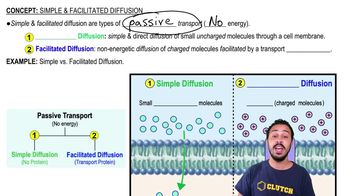
Understand the concept of facilitated diffusion: Facilitated diffusion is a type of passive transport where molecules move across a cell membrane with the help of transport proteins, without requiring energy input from the cell.
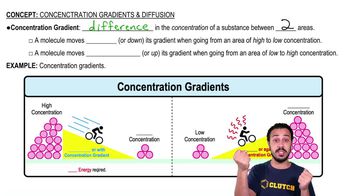
Recall the direction of movement in facilitated diffusion: Molecules move down their concentration gradient, meaning from an area of higher concentration to an area of lower concentration.
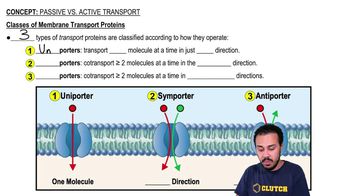
Identify the role of transport proteins: Transport proteins assist in the movement of specific molecules (e.g., glucose, ions) that cannot easily pass through the lipid bilayer of the membrane due to their size or polarity.
Eliminate options that involve energy: Facilitated diffusion does not require energy (ATP), so options involving energy can be ruled out.
Select the correct answer based on the above understanding: The correct choice must include transport proteins and movement down the concentration gradient.

Verified video answer for a similar problem:

This video solution was recommended by our tutors as helpful for the problem above.
Video duration:
2m
Was this helpful?

Key Concepts

Here are the essential concepts you must grasp in order to answer the question correctly.

Facilitated Diffusion

Facilitated diffusion is a passive transport process that allows substances to cross membranes with the assistance of special proteins. Unlike simple diffusion, which occurs directly through the lipid bilayer, facilitated diffusion requires specific transport proteins that help move molecules across the membrane without the expenditure of energy.
Recommended video:
Guided course
05:10
Simple and Facilitated Diffusion

Concentration Gradient

A concentration gradient refers to the difference in the concentration of a substance across a space or membrane. Molecules tend to move from areas of higher concentration to areas of lower concentration, which is known as moving 'down' the concentration gradient. This natural tendency is the driving force behind passive transport processes like facilitated diffusion.
Recommended video:
Guided course
04:51
Concentration Gradients and Diffusion

Transport Proteins

Transport proteins are integral membrane proteins that facilitate the movement of ions and molecules across the cell membrane. They can be specific to certain substances and play a crucial role in processes like facilitated diffusion, where they provide a pathway for solutes to move down their concentration gradient without the need for energy input.
Recommended video:
Guided course
03:28
Classes of Membrane Transport Proteins