
Pearson+ LogoPearson+ Logo
Ch. 5 The Working Cell
Taylor - Campbell Biology: Concepts & Connections 10th Edition
Taylor, Simon, Dickey, Hogan10th EditionCampbell Biology: Concepts & ConnectionsISBN: 9780136538783Not the one you use?Change textbook
Chapter 5, Problem 6

The synthesis of ATP from ADP and
a. Stores energy in a form that can drive cellular work
b. Involves the hydrolysis of a phosphate bond
c. Transfers a phosphate, priming a protein to do work
d. Is an exergonic process

Verified step by step guidance
1
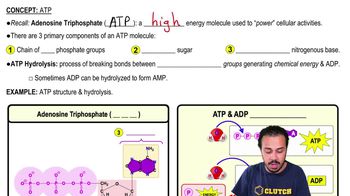
Understand the process of ATP synthesis: ATP (adenosine triphosphate) is synthesized from ADP (adenosine diphosphate) and inorganic phosphate (Pi) through a process called phosphorylation. This reaction is crucial for storing energy in cells.
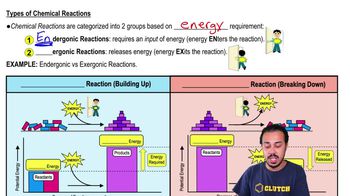
Recall that ATP synthesis is an endergonic process: Energy is required to add a phosphate group to ADP, forming ATP. This energy is typically provided by cellular respiration or photosynthesis.
Recognize the role of ATP in cellular work: ATP acts as an energy currency in cells. When ATP is hydrolyzed back to ADP and Pi, it releases energy that can be used to drive various cellular processes, such as muscle contraction, active transport, and chemical reactions.
Clarify the concept of phosphate transfer: ATP can transfer its terminal phosphate group to other molecules, a process called phosphorylation. This primes proteins or other molecules to perform work, such as changing their shape or activating enzymes.
Review the energy dynamics: ATP synthesis stores energy in a high-energy phosphate bond, which is later released during hydrolysis. This stored energy is not an exergonic process but rather an energy-storing mechanism.

Verified video answer for a similar problem:

This video solution was recommended by our tutors as helpful for the problem above.
Video duration:
5m
Was this helpful?

Key Concepts

Here are the essential concepts you must grasp in order to answer the question correctly.

ATP Synthesis

ATP (adenosine triphosphate) synthesis is the process by which energy is stored in the form of ATP from ADP (adenosine diphosphate) and inorganic phosphate. This process is crucial for cellular functions, as ATP serves as the primary energy currency of the cell, enabling various biochemical reactions and cellular work.
Recommended video:

Phosphate Bond Hydrolysis

The hydrolysis of a phosphate bond refers to the chemical reaction where a phosphate group is removed from ATP, releasing energy. This reaction is essential for driving cellular processes, as the energy released from breaking the bond is harnessed for various biological activities, including muscle contraction and active transport.
Recommended video:
Guided course
05:03
Hydrogen Bonding

Exergonic vs. Endergonic Reactions

Exergonic reactions are those that release energy, while endergonic reactions require energy input. The synthesis of ATP from ADP is an endergonic process, as it requires energy to form the high-energy phosphate bonds. Understanding the energy dynamics between these types of reactions is vital for grasping how cells manage energy for metabolic activities.
Recommended video:
Guided course
05:48
Types of Chemical Reactions