a. Estimate lim x→π/4 cos 2x / cos x − sin x by making a table of values of cos 2x / cos x − sin x for values of x approaching π/4. Round your estimate to four digits.
Ch. 2 - Limits
Briggs3rd EditionCalculus: Early TranscendentalsISBN: 9780136847243Not the one you use?Change textbook
Chapter 2, Problem 2.5.55a
Complete the following steps for the given functions.
a. Find the slant asymptote of .
Verified step by step guidance1
Identify that the function \( f(x) = \frac{4x^3 + 4x^2 + 7x + 4}{x^2 + 1} \) is a rational function where the degree of the numerator (3) is one more than the degree of the denominator (2). This indicates the presence of a slant (oblique) asymptote.
To find the slant asymptote, perform polynomial long division of the numerator \( 4x^3 + 4x^2 + 7x + 4 \) by the denominator \( x^2 + 1 \).
Divide the leading term of the numerator \( 4x^3 \) by the leading term of the denominator \( x^2 \) to get the first term of the quotient, which is \( 4x \).
Multiply the entire divisor \( x^2 + 1 \) by \( 4x \) and subtract the result from the original numerator to find the new polynomial.
Repeat the division process with the new polynomial until the degree of the remainder is less than the degree of the divisor. The quotient obtained (ignoring the remainder) represents the equation of the slant asymptote.

Verified video answer for a similar problem:
This video solution was recommended by our tutors as helpful for the problem above.
Video duration:
4mWas this helpful?
Key Concepts
Here are the essential concepts you must grasp in order to answer the question correctly.
Slant Asymptote
A slant (or oblique) asymptote occurs when the degree of the numerator of a rational function is exactly one higher than the degree of the denominator. To find it, perform polynomial long division on the function. The quotient (ignoring the remainder) gives the equation of the slant asymptote, which describes the behavior of the function as x approaches infinity.
Recommended video:
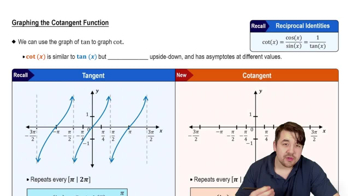
Introduction to Cotangent Graph
Polynomial Long Division
Polynomial long division is a method used to divide a polynomial by another polynomial of lower degree. It involves dividing the leading term of the numerator by the leading term of the denominator, multiplying the entire denominator by this result, and subtracting it from the numerator. This process is repeated until the degree of the remainder is less than that of the divisor.
Recommended video:
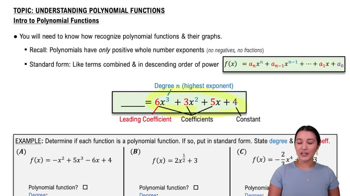
Introduction to Polynomial Functions
Rational Functions
Rational functions are expressions formed by the ratio of two polynomials. They can exhibit various behaviors, including vertical and horizontal asymptotes, depending on the degrees of the numerator and denominator. Understanding the properties of rational functions is crucial for analyzing their limits and asymptotic behavior, particularly as x approaches infinity or specific values.
Recommended video:
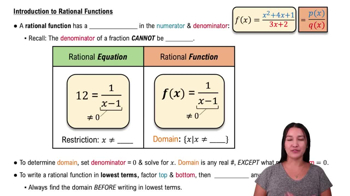
Intro to Rational Functions
Related Practice
Textbook Question
382
views
Textbook Question
Tangent lines with zero slope
a. Graph the function f(x)=x^2−4x+3.
402
views
Textbook Question
A projectile is fired vertically upward and has a position given by s(t)=−16t^2+128t+192, for 0≤t≤9.
a. Graph the position function, for 0≤t≤9.
389
views
Textbook Question
Complete the following sentences in terms of a limit.
b. A function is continuous from the right at a if _____ .
248
views
Textbook Question
A rock is dropped off the edge of a cliff, and its distance s (in feet) from the top of the cliff after t seconds is s(t)=16t^2. Assume the distance from the top of the cliff to the ground is 96 ft.
a. When will the rock strike the ground?
446
views
Textbook Question
Graph the function f(x)=e^−x / x(x+2)^2 using a graphing utility. (Experiment with your choice of a graphing window.) Use your graph to determine the following limits.
a. lim x→−2^+ f(x)
354
views