Ch. 11 - Power Series
Briggs - Calculus: Early Transcendentals 3rd Edition
Briggs3rd EditionCalculus: Early TranscendentalsISBN: 9780136847243Not the one you use?Change textbook
Chapter 11, Problem 11.2.53

Differentiating and integrating power series Find the power series representation for g centered at 0 by differentiating or integrating the power series for f (perhaps more than once). Give the interval of convergence for the resulting series.


g(x) = − 1/(1 + x)² using f(x) = 1/(1 + x)

Verified step by step guidance
1
Recall the given function and its power series: we have \( f(x) = \frac{1}{1+x} \). The power series representation of \( f(x) \) centered at 0 is the geometric series \( \sum_{n=0}^\infty (-1)^n x^n \), valid for \( |x| < 1 \).
Note that \( g(x) = -\frac{1}{(1+x)^2} \) can be expressed in terms of the derivative of \( f(x) \). Specifically, differentiate \( f(x) \) with respect to \( x \): \( f'(x) = \frac{d}{dx} \left( \frac{1}{1+x} \right) = -\frac{1}{(1+x)^2} \). This means \( g(x) = -f'(x) \).
Differentiate the power series for \( f(x) \) term-by-term: \( \frac{d}{dx} \sum_{n=0}^\infty (-1)^n x^n = \sum_{n=0}^\infty (-1)^n \frac{d}{dx} x^n = \sum_{n=1}^\infty (-1)^n n x^{n-1} \). Note that the \( n=0 \) term vanishes upon differentiation.
Since \( g(x) = -f'(x) \), multiply the differentiated series by \( -1 \) to get the power series for \( g(x) \): \( g(x) = - \sum_{n=1}^\infty (-1)^n n x^{n-1} = \sum_{n=1}^\infty (-1)^{n+1} n x^{n-1} \).
The interval of convergence remains the same as for \( f(x) \) because differentiation does not change the radius of convergence. Therefore, the interval of convergence for \( g(x) \) is \( |x| < 1 \).

Verified video answer for a similar problem:

This video solution was recommended by our tutors as helpful for the problem above.
Video duration:
9m
Was this helpful?

Key Concepts

Here are the essential concepts you must grasp in order to answer the question correctly.

Power Series Representation

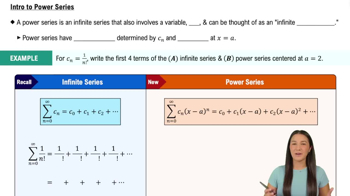
A power series is an infinite sum of terms in the form a_n(x - c)^n, representing functions as polynomials with infinitely many terms centered at c. Understanding how to express functions as power series allows manipulation through differentiation or integration term-by-term.
Recommended video:
05:58
Intro to Power Series

Term-by-Term Differentiation and Integration of Power Series

Power series can be differentiated or integrated term-by-term within their interval of convergence. This property enables finding new series representations for related functions by applying calculus operations to each term individually.
Recommended video:
05:58
Intro to Power Series

Interval of Convergence

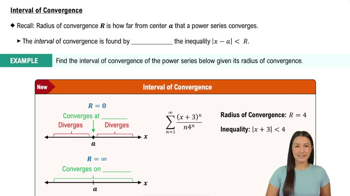
The interval of convergence is the set of x-values for which a power series converges to a finite value. When differentiating or integrating a power series, the interval of convergence may change, so determining it is essential for the validity of the resulting series.
Recommended video:
08:44
Interval of Convergence