Ch. 2 - Limits
Briggs - Calculus: Early Transcendentals 3rd Edition
Briggs3rd EditionCalculus: Early TranscendentalsISBN: 9780136847243Not the one you use?Change textbook
Chapter 2, Problem 2.2.21

Sketch a graph of f and use it to make a conjecture about the values of f(a), lim x→a^−f(x),lim x→a^+f(x), and lim x→a f(x) or state that they do not exist.
f(x) = {√x if x<4
3 if x=4; a=4
x+1 if x>4

Verified step by step guidance
1
Step 1: Understand the piecewise function f(x). It is defined as f(x) = \(\sqrt{x}\) for x < 4, f(x) = 3 for x = 4, and f(x) = x + 1 for x > 4.
Step 2: Sketch the graph of each piece of the function. For x < 4, plot the curve of \(\sqrt{x}\), which is a part of the square root function starting from the origin and increasing as x approaches 4.
Step 3: At x = 4, plot the point (4, 3) since f(x) = 3 when x = 4. This is a single point on the graph.
Step 4: For x > 4, plot the line x + 1, which starts at (4, 5) and increases linearly. Note that this line does not include the point (4, 5) since x > 4.
Step 5: Analyze the graph to make conjectures about the limits. Observe the behavior of the function as x approaches 4 from the left and right, and compare these to the value of f(4).

Verified video answer for a similar problem:

This video solution was recommended by our tutors as helpful for the problem above.
Video duration:
8m
Was this helpful?

Key Concepts

Here are the essential concepts you must grasp in order to answer the question correctly.

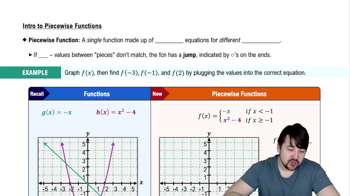
Piecewise Functions

A piecewise function is defined by different expressions based on the input value. In this case, f(x) has three distinct definitions depending on whether x is less than, equal to, or greater than 4. Understanding how to evaluate and graph these segments is crucial for analyzing the function's behavior at specific points.
Recommended video:
05:36
Piecewise Functions

Limits

Limits describe the behavior of a function as the input approaches a certain value. The left-hand limit (lim x→a^−f(x)) and right-hand limit (lim x→a^+f(x)) are essential for determining continuity at a point. If both limits exist and are equal, the overall limit (lim x→a f(x)) exists and equals that common value.
Recommended video:
05:50
One-Sided Limits

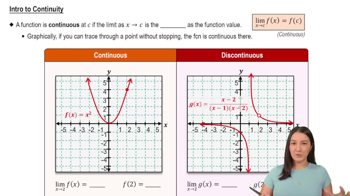
Continuity

A function is continuous at a point if the limit as x approaches that point equals the function's value at that point. For f(x) at x=4, we need to check if lim x→4^−f(x) equals lim x→4^+f(x) and if both equal f(4). If they do not match, the function is discontinuous at that point, which affects the conjecture about the function's values.
Recommended video:
05:34
Intro to Continuity
Related Practice
Textbook Question

Determine limxf(x)\(\lim\)_{x\(\rightarrow\]\infty\)}f\(\left\)(x\(\right\)) and limxf(x)\(\lim\)_{x\(\rightarrow\)-\(\infty\)}f\(\left\)(x\(\right\)) for the following functions. Then give the horizontal asymptotes of ff (if any).


f(x)=4x(3x9x2+1)f\(\left\)(x\(\right\))=4x\(\left\)(3x-\(\sqrt{9x^2+1}\]\right\))

348
views
Textbook Question

Determine limxf(x)\(\lim\)_{x\(\rightarrow\]\infty\)}f\(\left\)(x\(\right\)) and limxf(x)\(\lim\)_{x\(\rightarrow\)-\(\infty\)}f\(\left\)(x\(\right\)) for the following functions. Then give the horizontal asymptotes of ff (if any).


f(x)=6x29x+83x2+2f\(\left\)(x\(\right\))=\(\frac{6x^2-9x+8}{3x^2+2}\)

391
views
Textbook Question

Sketch a possible graph of a function f that satisfies all of the given conditions. Be sure to identify all vertical and horizontal asymptotes.

f(1)=2f\(\left\)(-1\(\right\))=-2, f(1)=2f\(\left\)(1\(\right\))=2, f(0)=0f\(\left\)(0\(\right\))=0, limxf(x)=1{\(\displaystyle\[\lim\)_{x\(\to\]\infty\)}{f(x)=1}}, limxf(x)=1{\(\displaystyle\]\lim\)_{x\(\to\)-\(\infty\)}{f(x)=-1}}

521
views
Textbook Question

Determine limxf(x)\(\lim\)_{x\(\rightarrow\]\infty\)}f\(\left\)(x\(\right\)) and limxf(x)\(\lim\)_{x\(\rightarrow\)-\(\infty\)}f\(\left\)(x\(\right\)) for the following functions. Then give the horizontal asymptotes of ff (if any).


f(x)=x6+834x2+3x4+1f\(\left\)(x\(\right\))=\(\frac{\sqrt[3]{x^6+8}\)}{4x^2+\(\sqrt{3x^4+1}\)}

323
views
Textbook Question

Determine the following limits.

limtcos(t)e3t{\(\displaystyle\[\lim\)_{t\(\to\]\infty\)}\(\frac{\cos\left(t\right)}{e^{3t}\)}}

376
views
Textbook Question

Evaluate each limit and justify your answer. 

lim t→4 t−4 /√t−2

367
views