
Ch. 5 - Integration
Briggs - Calculus: Early Transcendentals 3rd Edition
Briggs3rd EditionCalculus: Early TranscendentalsISBN: 9780136847243Not the one you use?Change textbook
Chapter 5, Problem 5.1.59c

Explain why or why not Determine whether the following statements are true and give an explanation or counterexample.
(c) For an increasing or decreasing nonconstant function on an interval [a,b] and a given value of n, the value of the midpoint Riemann sum always lies between the values of the left and right Riemann sums.

Verified step by step guidance
1
Understand the problem: The question asks us to determine whether the midpoint Riemann sum for a nonconstant, increasing or decreasing function on an interval [a, b] always lies between the left and right Riemann sums. We need to analyze this statement and provide reasoning or a counterexample.
Recall the definitions: The left Riemann sum (LRS) uses the left endpoints of subintervals to approximate the integral, while the right Riemann sum (RRS) uses the right endpoints. The midpoint Riemann sum (MRS) uses the midpoints of subintervals. For an increasing function, LRS underestimates the integral, and RRS overestimates it. For a decreasing function, the opposite is true.
Analyze the behavior for an increasing function: For an increasing function, the function values at the midpoints of subintervals are greater than the left endpoints but less than the right endpoints. This suggests that the midpoint Riemann sum should lie between the left and right Riemann sums.
Analyze the behavior for a decreasing function: For a decreasing function, the function values at the midpoints of subintervals are less than the left endpoints but greater than the right endpoints. This also suggests that the midpoint Riemann sum should lie between the left and right Riemann sums.
Conclude and justify: Based on the analysis, the statement is true. For a nonconstant, increasing or decreasing function, the midpoint Riemann sum always lies between the left and right Riemann sums because the midpoint values are intermediate between the left and right endpoint values for each subinterval.

Verified video answer for a similar problem:

This video solution was recommended by our tutors as helpful for the problem above.
Video duration:
1m
Was this helpful?

Key Concepts

Here are the essential concepts you must grasp in order to answer the question correctly.

Riemann Sums

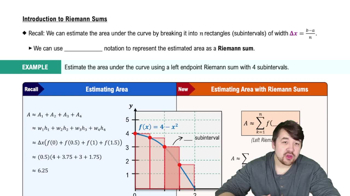
Riemann sums are a method for approximating the integral of a function over an interval by dividing the interval into subintervals and summing the areas of rectangles formed. The left Riemann sum uses the left endpoints of the subintervals, while the right Riemann sum uses the right endpoints. The midpoint Riemann sum, on the other hand, uses the midpoints of the subintervals, which can provide a more accurate approximation of the area under the curve.
Recommended video:
06:11
Introduction to Riemann Sums

Monotonic Functions

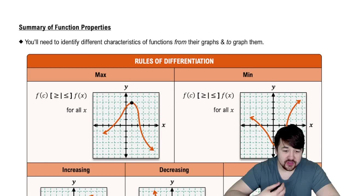
A monotonic function is one that is either entirely non-increasing or non-decreasing over a given interval. For an increasing function, as the input values increase, the output values also increase, while for a decreasing function, the output values decrease. Understanding the behavior of monotonic functions is crucial when analyzing the relationships between different types of Riemann sums, as it affects the placement of the rectangles used in the approximations.
Recommended video:
06:21
Properties of Functions

Comparison of Riemann Sums

When comparing Riemann sums for a monotonic function, the midpoint Riemann sum typically lies between the left and right Riemann sums. This is because the midpoint captures the average height of the function over each subinterval, while the left and right sums can overestimate or underestimate the area depending on the function's behavior. This property is particularly important in understanding the accuracy of numerical integration methods.
Recommended video:
06:11
Introduction to Riemann Sums
Related Practice
Textbook Question

{Use of Tech} Approximating net area The following functions are positive and negative on the given interval.

Ζ’(𝓍) = tan⁻¹ (3x - 1) on [0,1]

(b) Approximate the net area bounded by the graph of f and the x-axis on the interval using a left, right, and midpoint Riemann sum with n = 4.

65
views
Textbook Question

Sigma notation Evaluate the following expressions.                                                                                                                                          

(c)     4                                                                                                                                                                               

       βˆ‘ ΞΊΒ²                                                                                                                                                                          

       ΞΊ=1                         

Textbook Question

Properties of integrals Use only the fact that βˆ«β‚€β΄ 3𝓍 (4 ―𝓍) d𝓍 = 32, and the definitions and properties of integrals, to evaluate the following integrals, if possible.


(c) βˆ«β‚„β° 6𝓍(4 ― 𝓍) d(𝓍)

57
views
Textbook Question

Using properties of integrals Use the value of the first integral I to evaluate the two given integrals. 

I = βˆ«β‚€^Ο€/2 (cos ΞΈ ― 2 sin ΞΈ) dΞΈ = ―1

(b) βˆ«β‚€^Ο€/2 (4 cos ΞΈ ― 8 sin ΞΈ) dΞΈ

77
views
Textbook Question

Matching functions with area functions Match the functions Ζ’, whose graphs are given in a― d, with the area functions A (𝓍) = βˆ«β‚€Λ£ Ζ’(t) dt, whose graphs are given in A–D.


70
views
Textbook Question

Working with area functions Consider the function Ζ’ and the points a, b, and c.

(c) Evaluate A(b) and A(c). Interpret the results using the graphs of part (b) .

Ζ’(𝓍) = ― 12𝓍 (𝓍―1) (𝓍― 2) ; a = 0 , b = 1 , c = 2

62
views