
Ch. 10 - Sequences and Infinite Series
Briggs - Calculus: Early Transcendentals 3rd Edition
Briggs3rd EditionCalculus: Early TranscendentalsISBN: 9780136847243Not the one you use?Change textbook
Chapter 10, Problem 10.1.75b

72–75. {Use of Tech} Practical sequences
Consider the following situations that generate a sequence


b.Find an explicit formula for the terms of the sequence.


Drug elimination
Jack took a 200-mg dose of a pain killer at midnight. Every hour, 5% of the drug is washed out of his bloodstream. Let dₙ be the amount of drug in Jack’s blood n hours after the drug was taken, where d₀ = 200mg.

Verified step by step guidance
1
Identify the type of sequence described in the problem. Since the drug amount decreases by a fixed percentage each hour, this is a geometric sequence.
Determine the initial term of the sequence, which is the amount of drug at time zero: \(d_0 = 200\) mg.
Find the common ratio \(r\) of the geometric sequence. Since 5% of the drug is eliminated each hour, 95% remains, so \(r = 1 - 0.05 = 0.95\).
Write the explicit formula for the \(n\)-th term of the sequence using the geometric sequence formula: \(d_n = d_0 \times r^n\).
Substitute the known values into the formula to get \(d_n = 200 \times (0.95)^n\), which expresses the amount of drug in the bloodstream \(n\) hours after the dose.

Verified video answer for a similar problem:

This video solution was recommended by our tutors as helpful for the problem above.
Video duration:
3m
Was this helpful?

Key Concepts

Here are the essential concepts you must grasp in order to answer the question correctly.

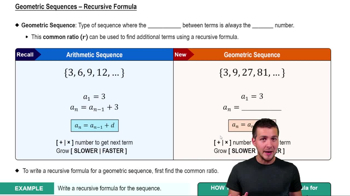
Geometric Sequences

A geometric sequence is a sequence where each term is found by multiplying the previous term by a constant ratio. In this problem, the drug amount decreases by a fixed percentage each hour, making it a geometric sequence with a common ratio less than 1.
Recommended video:
Guided course
04:18
Geometric Sequences - Recursive Formula

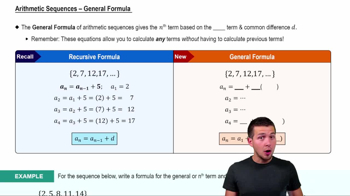
Explicit Formula for Sequences

The explicit formula expresses the nth term of a sequence directly in terms of n, without needing previous terms. For a geometric sequence, the formula is dₙ = d₀ × rⁿ, where d₀ is the initial term and r is the common ratio.
Recommended video:
Guided course
5:17
Arithmetic Sequences - General Formula

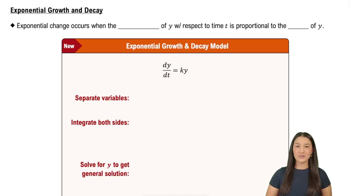
Exponential Decay

Exponential decay describes processes where quantities decrease by a consistent percentage over equal time intervals. Here, the drug amount reduces by 5% each hour, so the remaining amount follows an exponential decay model.
Recommended video:
09:29
Exponential Growth & Decay