Ch. 3 - Derivatives
Briggs - Calculus: Early Transcendentals 3rd Edition
Briggs3rd EditionCalculus: Early TranscendentalsISBN: 9780136847243Not the one you use?Change textbook
Chapter 3, Problem 30c

Consider the following cost functions.
c. Interpret the values obtained in part (b).
C(x) = 500+0.02x, 0≤x≤2000, a=1000

Verified step by step guidance
1
First, identify the cost function given: C(x) = 500 + 0.02x, where x represents the number of units produced.
Next, understand the range of x, which is 0 ≤ x ≤ 2000. This means the function is valid for production levels between 0 and 2000 units.
In part (b), you would typically be asked to evaluate the cost function at a specific value of x, which in this case is a = 1000. Substitute x = 1000 into the cost function to find C(1000).
Calculate C(1000) using the formula: C(1000) = 500 + 0.02 * 1000. This will give you the total cost when 1000 units are produced.
Interpret the result obtained from C(1000). The value represents the total cost of producing 1000 units, which includes a fixed cost of 500 and a variable cost that depends on the number of units produced.

Verified video answer for a similar problem:

This video solution was recommended by our tutors as helpful for the problem above.
Video duration:
3m
Was this helpful?

Key Concepts

Here are the essential concepts you must grasp in order to answer the question correctly.

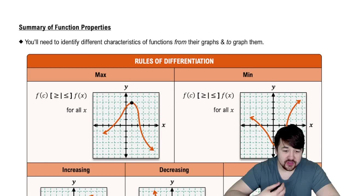
Cost Function

A cost function represents the total cost incurred by a business in producing a certain quantity of goods, denoted as C(x). In this case, C(x) = 500 + 0.02x indicates that there is a fixed cost of 500 and a variable cost of 0.02 per unit produced. Understanding this function is crucial for analyzing how costs change with production levels.
Recommended video:
06:21
Properties of Functions

Interpretation of Values

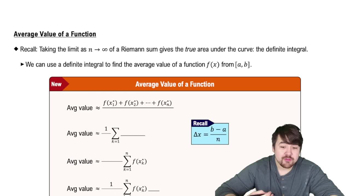
Interpreting values from a cost function involves understanding what the numerical outputs signify in a real-world context. For instance, in part (b), if a specific value of x is substituted into C(x), the resulting cost can be analyzed to determine the financial implications of producing that quantity, including profitability and cost management.
Recommended video:
06:37
Average Value of a Function

Domain of the Function

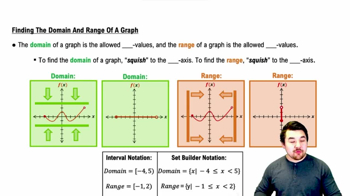
The domain of a function specifies the set of input values for which the function is defined. In this case, the domain is 0 ≤ x ≤ 2000, meaning the cost function is only applicable for production levels between 0 and 2000 units. Recognizing the domain is essential for ensuring that any analysis or interpretation of the cost function remains relevant and valid within the specified limits.
Recommended video:
5:10
Finding the Domain and Range of a Graph