Ch. 3 - Derivatives
Briggs - Calculus: Early Transcendentals 3rd Edition
Briggs3rd EditionCalculus: Early TranscendentalsISBN: 9780136847243Not the one you use?Change textbook
Chapter 3, Problem 53c

Where is the function continuous? Differentiable? Use the graph of f in the figure to do the following. <IMAGE>
c. Sketch a graph of f'.

Verified step by step guidance
1
Step 1: Understand the concepts of continuity and differentiability. A function is continuous at a point if there is no interruption in the graph at that point. A function is differentiable at a point if it has a defined tangent (slope) at that point, meaning the graph is smooth and not sharp or vertical.
Step 2: Analyze the graph of the function f. Look for any points where the graph has breaks, jumps, or vertical asymptotes, as these indicate points of discontinuity. Also, identify any sharp corners or cusps, as these indicate points where the function is not differentiable.
Step 3: Determine the intervals of continuity. Identify the intervals on the x-axis where the graph of f is unbroken and smooth. These intervals represent where the function is continuous.
Step 4: Determine the intervals of differentiability. Identify the intervals on the x-axis where the graph of f is smooth and has no sharp corners or vertical tangents. These intervals represent where the function is differentiable.
Step 5: Sketch the graph of f'. Use the information about differentiability to sketch the derivative f'. The derivative will be defined and smooth over the intervals where f is differentiable. Pay attention to the slopes of f in these intervals to sketch f'.

Verified video answer for a similar problem:

This video solution was recommended by our tutors as helpful for the problem above.
Video duration:
3m
Was this helpful?

Key Concepts

Here are the essential concepts you must grasp in order to answer the question correctly.

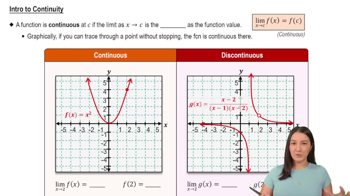
Continuity

A function is continuous at a point if the limit of the function as it approaches that point equals the function's value at that point. This means there are no breaks, jumps, or holes in the graph of the function. For a function to be continuous over an interval, it must be continuous at every point within that interval.
Recommended video:
05:34
Intro to Continuity

Differentiability

A function is differentiable at a point if it has a defined derivative at that point, which implies that the function is smooth and has no sharp corners or vertical tangents. If a function is not continuous at a point, it cannot be differentiable there. Differentiability is a stronger condition than continuity.
Recommended video:
05:53
Finding Differentials

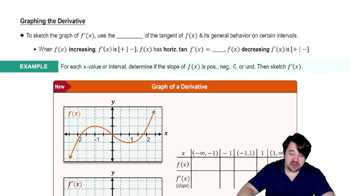
Graph of the Derivative

The graph of the derivative, f', represents the slope of the tangent line to the function f at each point. Key features of f' include identifying where f is increasing or decreasing (f' > 0 or f' < 0, respectively) and where f has local maxima or minima (where f' = 0). Sketching f' involves analyzing the original function's behavior, including its critical points and intervals of increase or decrease.
Recommended video:
06:15
Graphing The Derivative