Ch. 3 - Derivatives
Briggs - Calculus: Early Transcendentals 3rd Edition
Briggs3rd EditionCalculus: Early TranscendentalsISBN: 9780136847243Not the one you use?Change textbook
Chapter 3, Problem 3.1.49

Interpreting the derivative Find the derivative of each function at the given point and interpret the physical meaning of this quantity. Include units in your answer.
An object dropped from rest falls d(t)=16t² feet in t seconds. Find d′(4).

Verified step by step guidance
1
First, identify the function given: \( d(t) = 16t^2 \). This represents the distance fallen by an object in feet as a function of time \( t \) in seconds.
To find the derivative \( d'(t) \), apply the power rule of differentiation. The power rule states that if \( f(t) = at^n \), then \( f'(t) = nat^{n-1} \).
Using the power rule, differentiate \( d(t) = 16t^2 \) to get \( d'(t) = 32t \). This derivative represents the velocity of the object in feet per second.
Evaluate the derivative at the given point \( t = 4 \) seconds: \( d'(4) = 32 \times 4 \). This calculation will give the velocity of the object at 4 seconds.
Interpret the result: The value of \( d'(4) \) represents the instantaneous velocity of the object at \( t = 4 \) seconds. The units of this derivative are feet per second, indicating how fast the object is falling at that specific moment in time.

Verified video answer for a similar problem:

This video solution was recommended by our tutors as helpful for the problem above.
Video duration:
3m
Was this helpful?

Key Concepts

Here are the essential concepts you must grasp in order to answer the question correctly.

Derivative

The derivative of a function measures the rate at which the function's value changes as its input changes. In the context of motion, it represents the object's velocity at a specific time. For the function d(t) = 16t², the derivative d′(t) gives the instantaneous velocity of the object at time t.
Recommended video:
05:44
Derivatives

Physical Interpretation of Derivatives

In physics, the derivative can be interpreted as a measure of how a physical quantity changes over time. For example, in the case of an object in free fall, the derivative of the distance function with respect to time gives the velocity, which indicates how fast the object is falling at any given moment.
Recommended video:
05:44
Derivatives

Units of Measurement

When calculating derivatives in a physical context, it is essential to include units to convey meaningful information. In this case, the distance function d(t) is measured in feet, and time t is measured in seconds. Therefore, the derivative d′(t) will have units of feet per second, representing the velocity of the falling object.
Recommended video:
5:10
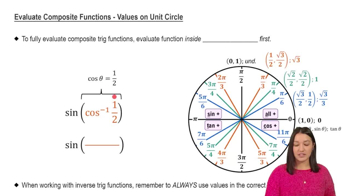
Evaluate Composite Functions - Values on Unit Circle