
Textbook Question
Composition of Functions
Let f(x) = x − 3, g(x) = √x, h(x) = x³, and j(x) = 2x. Express each of the functions in Exercises 11 and 12 as a composition involving one or more of f, g, h, and j.
a. y = 2x − 3
185
views

 Verified step by step guidance
 3:48
3:48
 04:22
04:22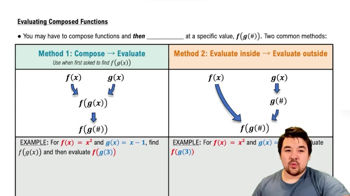 4:26
4:26Composition of Functions
Let f(x) = x − 3, g(x) = √x, h(x) = x³, and j(x) = 2x. Express each of the functions in Exercises 11 and 12 as a composition involving one or more of f, g, h, and j.
a. y = 2x − 3
Functions and Graphs
Graph the following equations and explain why they are not graphs of functions of x.
a. |x| + |y| = 1
Piecewise-Defined Functions
Find a formula for each function graphed in Exercises 29–32.
b. <IMAGE>
Theory and Examples
The accompanying figure shows a rectangle inscribed in an isosceles right triangle whose hypotenuse is 2 units long.
a. Express the y-coordinate of P in terms of x. (You might start by writing an equation for the line AB.)
<IMAGE>
Functions
In Exercises 7 and 8, which of the graphs are graphs of functions of x, and which are not? Give reasons for your answers.
b. <IMAGE>
Functions and Graphs
Graph the following equations and explain why they are not graphs of functions of x.
a. |y| = x