Back
Back
Problem 1
Finding Derivative Functions and Values
Using the definition, calculate the derivatives of the functions in Exercises 1–6. Then find the values of the derivatives as specified.
f(x) = 4 – x²; f′(−3), f′(0), f′(1)
Problem 2.9.46b
The edge x of a cube is measured with an error of at most 0.5%. What is the maximum corresponding percentage error in computing the cube’s
b. volume?
Problem 3.9.35
Differential Estimates of Change
In Exercises 35–40, write a differential formula that estimates the given change in volume or surface area.
The change in the volume V = (4/3)πr³ of a sphere when the radius changes from r₀ to r₀ + dr
Problem 3.5.49
Theory and Examples
The equations in Exercises 49 and 50 give the position s = f(t) of a body moving on a coordinate line (s in meters, t in seconds). Find the body’s velocity, speed, acceleration, and jerk at time t = π/4 sec.
s = 2 − 2 sin t
Problem 3.1.18
In Exercises 11–18, find the slope of the function’s graph at the given point. Then find an equation for the line tangent to the graph there.
f(x) = √(x + 1), (8, 3)
Problem 3.6.9
In Exercises 9–18, write the function in the form y = f(u) and u = g(x). Then find dy/dx as a function of x.
y = (2x + 1)⁵
Problem 3.9.47
Tolerance The height and radius of a right circular cylinder are equal, so the cylinder’s volume is V = πh³. The volume is to be calculated with an error of no more than 1% of the true value. Find approximately the greatest error that can be tolerated in the measurement of h, expressed as a percentage of h.
Problem 3.6.39
Find the derivatives of the functions in Exercises 19–40.
q = sin(t / (√t + 1))
Problem 3.19
Find the derivatives of the functions in Exercises 1–42.
___
𝓻 = sin √ 2θ
Problem 3.6.74
If r = sin(f(t)), f(0) = π/3, and f'(0) = 4, then what is dr/dt at t = 0?
Problem 3.5.17
Derivatives
In Exercises 1–18, find dy/dx.
f(x) = x³ sin x cos x
Problem 3.8.36
Moving along a parabola A particle moves along the parabola y = x² in the first quadrant in such a way that its x-coordinate (measured in meters) increases at a steady 10 m/sec. How fast is the angle of inclination θ of the line joining the particle to the origin changing when x = 3 m?
Problem 3.2.29
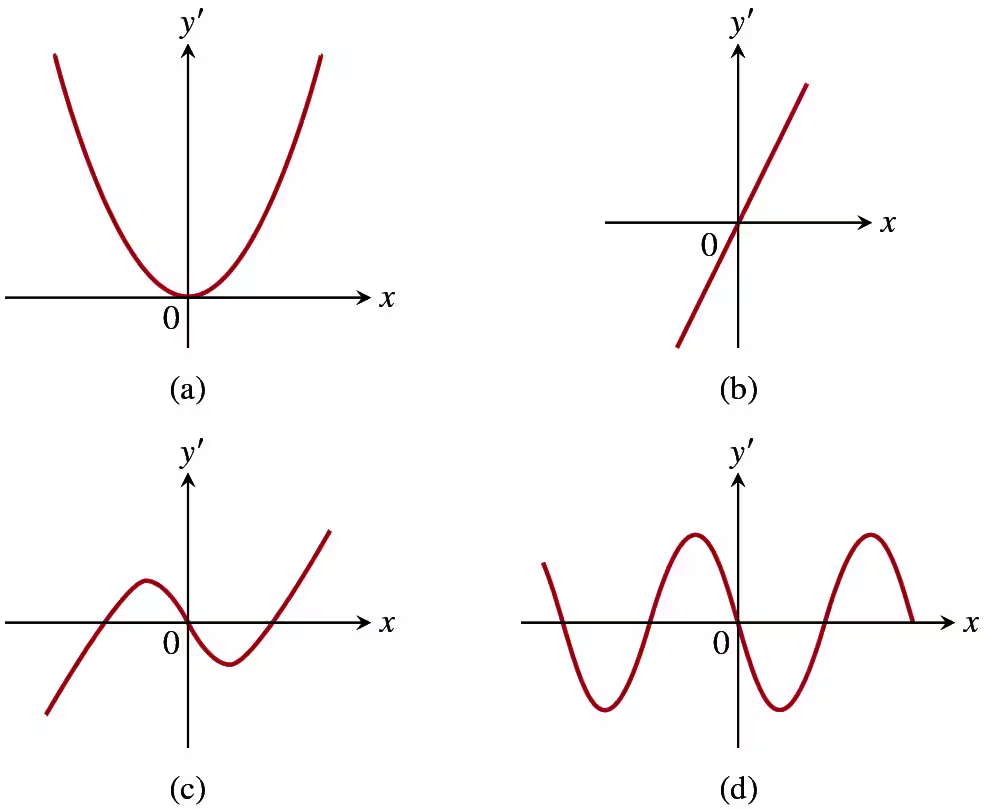
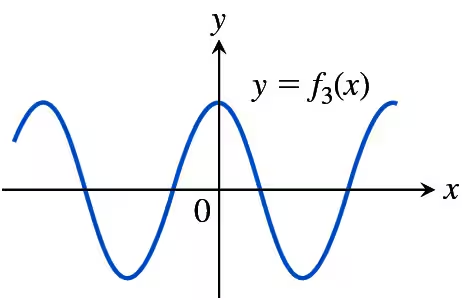
Graphs
Match the functions graphed in Exercises 27–30 with the derivatives graphed in the accompanying figures (a)–(d).
Problem 3.7.16
Find dr/dθ in Exercises 15–18.
r – 2√θ = (3/2)θ²/³ + (4/3)θ³/⁴
Problem 3.5.29
Derivatives
In Exercises 27–32, find dp/dq.
p = (sin q + cos q) / cos q
Problem 3.3.55
For Exercises 55 and 56, evaluate each limit by first converting each to a derivative at a particular x-value.
lim (x → 1) (x⁵⁰ − 1) / (x − 1)
Problem 3.5.24
Derivatives
In Exercises 23–26, find dr/dθ.
r = θ sin θ + cos θ
Problem 3.7.1
Differentiating Implicitly
Use implicit differentiation to find dy/dx in Exercises 1–14.
x²y + xy² = 6
Problem 3.6.69
Finding Derivative Values
In Exercises 67–72, find the value of (f ∘ g)' at the given value of x.
f(u) = cot(πu/10), u = g(x) = 5√x, x = 1
Problem 3.9.23
Derivatives in Differential Form
In Exercises 17–28, find dy.
y = sin(5√x)
Problem 3.7.2
Differentiating Implicitly
Use implicit differentiation to find dy/dx in Exercises 1–14.
x³ + y³ = 18xy
Problem 3.1.10
In Exercises 5–10, find an equation for the tangent line to the curve at the given point. Then sketch the curve and tangent line together.
y = (1 / x³), (−2, −1/8)
Problem 3.8.6
If x = y³ – y and dy/dt = 5, then what is dx/dt when y = 2?
Problem 3.2.56
Tangent line to y = √x Does any tangent line to the curve y = √x cross the x-axis at x = −1? If so, find an equation for the line and the point of tangency. If not, why not?
Problem 3.6.48
In Exercises 41–58, find dy/dt.
y = ((3t − 4) / (5t + 2))⁻⁵
Problem 3.6.60
Second Derivatives
Find y'' in Exercises 59–64.
y = (1 − √x)⁻¹
Problem 3.6.43
In Exercises 41–58, find dy/dt.
y = (1 + cos(2t))⁻⁴
Problem 3.7.23
Second Derivatives
In Exercises 19–26, use implicit differentiation to find dy/dx and then d²y/dx². Write the solutions in terms of x and y only.
2√y = x – y
Problem 3.6.5
Derivative Calculations
In Exercises 1–8, given y = f(u) and u = g(x), find dy/dx = f'(g(x)) g'(x).
y = √u, u = sin x
Problem 3.6.51
In Exercises 41–58, find dy/dt.
y = (1 + tan⁴(t/12))³