Back
Back
Problem 1a
Finding Limits Graphically
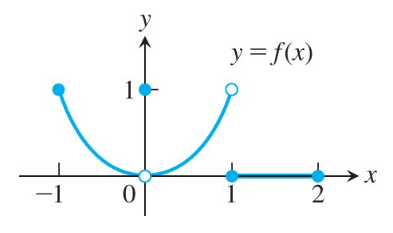
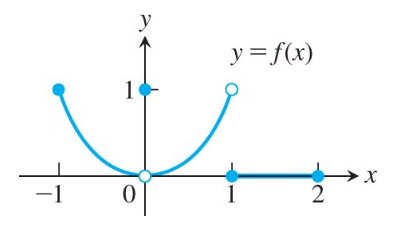
Which of the following statements about the function y = f(x) graphed here are true, and which are false?
a. limx→−1+ f(x) = 1
Problem 1c
Finding Limits Graphically
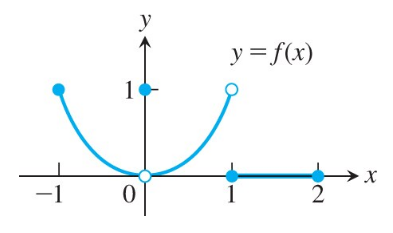
Which of the following statements about the function y = f(x) graphed here are true, and which are false?
c. limx→0− f(x) = 0
Problem 1e
Finding Limits Graphically
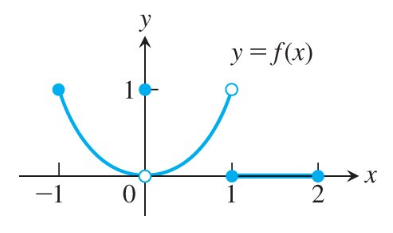
Which of the following statements about the function y = f(x) graphed here are true, and which are false?
e. limx→0 f(x) exists
Problem 1f
Finding Limits Graphically
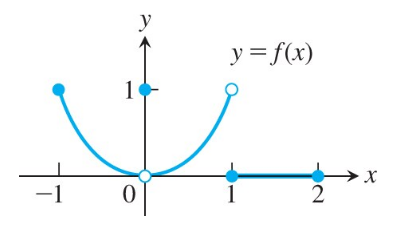
Which of the following statements about the function y = f(x) graphed here are true, and which are false?
f. limx→0 f(x) = 0
Problem 1j
Finding Limits Graphically
Which of the following statements about the function y = f(x) graphed here are true, and which are false?
j. limx→2− f(x) = 2
Problem 2.6.15
Limits of Rational Functions
In Exercises 13–22, find the limit of each rational function (a) as x → ∞ and (b) as x → −∞. Write ∞ or −∞ where appropriate.
f(x) = (x + 1)/(x² + 3)
Problem 2.6.37
Infinite Limits
Find the limits in Exercises 37–48. Write ∞ or −∞ where appropriate.
lim x→0⁺ 1 / 3x
Problem 2.49
Horizontal and Vertical Asymptotes
Determine the domain and range of y = (√16―x²) / (x―2).
Problem 2.5.72
Use the Intermediate Value Theorem in Exercises 69–74 to prove that each equation has a solution. Then use a graphing calculator or computer grapher to solve the equations.
x³ − 15x + 1 = 0 (three roots)
Problem 2.3.50
Using the Formal Definition
Prove the limit statements in Exercises 37–50.
lim x→0 x² sin (1/x) = 0
<IMAGE>
Problem 2.3.49
Using the Formal Definition
Prove the limit statements in Exercises 37–50.
lim x→0 x sin (1/x) = 0
<IMAGE>
Problem 2.4.28
Using limθ→0 sin θ / θ = 1
Find the limits in Exercises 23–46.
limt→0 2t / tan t
Problem 2.4.26
Using limθ→0 sin θ / θ = 1
Find the limits in Exercises 23–46.
limh→0− h / sin 3h
Problem 2.3.41
Using the Formal Definition
Prove the limit statements in Exercises 37–50.
limx→1 f(x) = 1 if f(x) = {x², x ≠ 1
2, x = 1
Problem 2.6.77
In Exercises 77–80, find a function that satisfies the given conditions and sketch its graph. (The answers here are not unique. Any function that satisfies the conditions is acceptable. Feel free to use formulas defined in pieces if that will help.)
lim x → ±∞ f(x) = 0, lim x → 2⁻ f(x) = ∞, and lim x → 2⁺ f(x) = ∞
Problem 2.4.14
Finding One-Sided Limits Algebraically
Find the limits in Exercises 11–20.
limx→1− (1/(x + 1))((x + 6)/x)((3 − x)/7)
Problem 2.2.60
Limits of Average Rates of Change
Because of their connection with secant lines, tangents, and instantaneous rates, limits of the form limh→0 (f(x+h) − f(x)) / h occur frequently in calculus. In Exercises 57–62, evaluate this limit for the given value of x and function f.
f(x) = 1/x, x = -2
Problem 2.25
Finding Limits
In Exercises 25–28, find the limit of g(x) as x approaches the indicated value.
lim (4g(x))¹/³ = 2
x →0
Problem 2.5.27
At what points are the functions in Exercises 13–30 continuous?
y = (2x – 1)¹/³
Problem 2.4.40
Using limθ→0 sin θ / θ = 1
Find the limits in Exercises 23–46.
limθ→0 sin θ cot 2θ
Problem 2.4.35
Using limθ→0 sin θ / θ = 1
Find the limits in Exercises 23–46.
limt→0 sin(1 − cos t) / (1 − cos t)
Problem 2.6.35
Limits as x → ∞ or x → −∞
The process by which we determine limits of rational functions applies equally well to ratios containing noninteger or negative powers of x. Divide numerator and denominator by the highest power of x in the denominator and proceed from there. Find the limits in Exercises 23–36. Write ∞ or −∞ where appropriate.
lim x→∞ (x − 3) / √(4x² + 25)
Problem 2.3.44
Using the Formal Definition
Prove the limit statements in Exercises 37–50.
limx → √3 1/x² = 1/3
Problem 2.4.16
Finding One-Sided Limits Algebraically
Find the limits in Exercises 11–20.
limh→0− (√6 − √(5h² + 11h + 6))/ h
Problem 2.2.17
Calculating Limits
Find the limits in Exercises 11–22.
limx→−1/2 4x(3x+4)²
Problem 2.38
Limits and Infinity
Find the limits in Exercises 37–46.
2x² + 3
lim -------------
x→⁻∞ 5x² + 7
Problem 2.3.37
Using the Formal Definition
Prove the limit statements in Exercises 37–50.
limx →4 (9 − x) = 5
Problem 2.8.84
Finding Limits of Differences When x → ±∞
Find the limits in Exercises 84–90. (Hint: Try multiplying and dividing by the conjugate.)
lim x → ∞ (√(x + 9) − √(x + 4))
Problem 2.2.58
Limits of Average Rates of Change
Because of their connection with secant lines, tangents, and instantaneous rates, limits of the form limh→0 (f(x+h) − f(x)) / h occur frequently in calculus. In Exercises 57–62, evaluate this limit for the given value of x and function f.
f(x) = x², x = -2
Problem 2.5.29
At what points are the functions in Exercises 13–30 continuous?
g(x) = { (x² − x – 6)/(x – 3), x ≠ 3
5, x = 3