Back
Back
Problem 1.3.54
Solving Trigonometric Equations
For Exercises 51–54, solve for the angle θ, where 0 ≤ θ ≤ 2π.
sin² θ = cos² θ
Problem 1.4.35
Use graphing software to graph the functions specified in Exercises 31–36.
Select a viewing window that reveals the key features of the function.
Graph the function f (x) = sin 2x + cos 3x.
Problem 1.1.1
Functions
In Exercises 1–6, find the domain and range of each function.
f(x) = 1 + x²
Problem 1.1.71
[Technology Exercise]
a. Graph the functions f(x) = x/2 and g(x) = 1 + (4/x) together to identify the values of x for which
x/2 > 1 + 4/x
b. Confirm your findings in part (a) algebraically.
Problem 1.2.2
Algebraic Combinations
In Exercises 1 and 2, find the domains of f, g, f + g, and f ⋅ g.
f(x) = √(x + 1), g(x) = √(x − 1)
Problem 1.1.35
The Greatest and Least Integer Functions
Does ⌊x⌋ = ⌈x⌉ for all real x? Give reasons for your answer.
Problem 1.1.37
Increasing and Decreasing Functions
Graph the functions in Exercises 37–46. What symmetries, if any, do the graphs have? Specify the intervals over which the function is increasing and the intervals where it is decreasing.
y = −x³
Problem 1.2.43
Graph the functions in Exercises 37–56.
y = (x + 1)²/³
Problem 1.1.46
Increasing and Decreasing Functions
Graph the functions in Exercises 37–46. What symmetries, if any, do the graphs have? Specify the intervals over which the function is increasing and the intervals where it is decreasing.
y = (−x)²/³
Problem 1.23
In Exercises 19–32, find the (a) domain and (b) range.
𝔂 = 2e⁻ˣ - 3
Problem 1.1.60
Even and Odd Functions
In Exercises 47–62, say whether the function is even, odd, or neither. Give reasons for your answer.
sin x²
Problem 1.1.16
Functions and Graphs
Find the natural domain and graph the functions in Exercises 15–20.
f(x) = 1 − 2x − x²
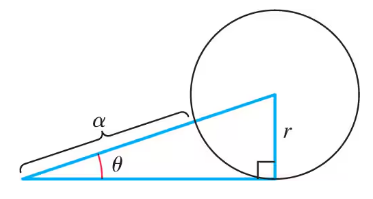
Problem 1.3.65
Refer to the given figure. Write the radius r of the circle in terms of α and θ.
Problem 1.1.52
Even and Odd Functions
In Exercises 47–62, say whether the function is even, odd, or neither. Give reasons for your answer.
g(x) = x⁴ + 3x² − 1
Problem 1.1.50
Even and Odd Functions
In Exercises 47–62, say whether the function is even, odd, or neither. Give reasons for your answer.
f(x) = x² + x
Problem 1.1.54
Even and Odd Functions
In Exercises 47–62, say whether the function is even, odd, or neither. Give reasons for your answer.
g(x) = x/(x² − 1)
Problem 1.2.39
Graph the functions in Exercises 37–56.
y = |x − 2|
Problem 1.3.36
Using the Addition Formulas
Use the addition formulas to derive the identities in Exercises 31–36.
sin (A − B) = sin A cos B − cos A sin B
Problem 1.3.42
In Exercises 39–42, express the given quantity in terms of sin x and cos x.
cos (3π/2 + x)
Problem 1.12
In Exercises 9–16, determine whether the function is even, odd, or neither.
𝔂 = sec x tan x
Problem 1.8
In Exercises 5–8, determine whether the graph of the function is symmetric about the 𝔂-axis, the origin, or neither.
𝔂 = e⁻ˣ²
Problem 1.2.23
Shifting Graphs
The accompanying figure shows the graph of y = −x² shifted to two new positions. Write equations for the new graphs.
<IMAGE>
Problem 1.2.4
Algebraic Combinations
In Exercises 3 and 4, find the domains of f, g, f/g and g/f.
f(x) = 1, g(x) = 1 + √x
Problem 1.4.29
Finding a Viewing Window
In Exercises 5–30, find an appropriate graphing software viewing window for the given function and use it to display that function’s graph. The window should give a picture of the overall behavior of the function. There is more than one choice, but incorrect choices can miss important aspects of the function.
y = x + (1/10) sin 30x
Problem 1.3.50
Using the Half-Angle Formulas
Find the function values in Exercises 47–50.
sin² 3π/8
Problem 1.1.10
Finding Formulas for Functions
Express the side length of a square as a function of the length d of the square’s diagonal. Then express the area as a function of the diagonal length.
Problem 1.16
In Exercises 9–16, determine whether the function is even, odd, or neither.
𝔂 = x cos x
Problem 1.1.14
Finding Formulas for Functions
Consider the point (x,y) lying on the graph of y = √(x − 3). Let L be the distance between the points (x,y) and (4,0). Write L as a function of y.
Problem 1.2.78
Graph the function y = √|x|.
Problem 1.1.5
Functions
In Exercises 1–6, find the domain and range of each function.
f(t) = 4/(3 − t)