Ch. 1 - Functions
Briggs - Calculus: Early Transcendentals 3rd Edition
Briggs3rd EditionCalculus: Early TranscendentalsISBN: 9780136847243Not the one you use?Change textbook
Chapter 1, Problem 39

Composite functions and notation
Let ƒ(x)= x² - 4 , g(x) = x³ and F(x) = 1/(x-3).
Simplify or evaluate the following expressions.
F(F(x))

Verified step by step guidance
1
Identify the function F(x) which is given as F(x) = \(\frac{1}{x-3}\).
To find F(F(x)), substitute F(x) into itself. This means replacing x in F(x) with F(x).
Substitute F(x) = \(\frac{1}{x-3}\) into F(x) to get F(F(x)) = \(\frac{1}{\frac{1}{x-3}\) - 3}.
Simplify the expression \(\frac{1}{\frac{1}{x-3}\) - 3} by finding a common denominator for the terms in the denominator.
The common denominator is x-3, so rewrite the expression as \(\frac{1}{\frac{1 - 3(x-3)}{x-3}\)} and simplify further.

Verified video answer for a similar problem:

This video solution was recommended by our tutors as helpful for the problem above.
Video duration:
2m
Was this helpful?

Key Concepts

Here are the essential concepts you must grasp in order to answer the question correctly.

Composite Functions

Composite functions are formed when one function is applied to the result of another function. In this case, F(F(x)) means that we first evaluate F at x, and then take that result and use it as the input for F again. Understanding how to combine functions is crucial for simplifying expressions involving multiple functions.
Recommended video:
3:48
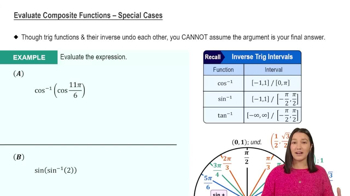
Evaluate Composite Functions - Special Cases

Function Notation

Function notation is a way to denote functions and their operations clearly. For example, F(x) represents the function F evaluated at x. Recognizing how to read and interpret function notation is essential for working with composite functions and understanding the relationships between different functions.
Recommended video:
7:24
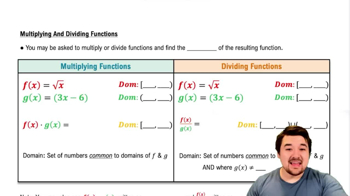
Multiplying & Dividing Functions

Simplification of Expressions

Simplification involves reducing an expression to its simplest form, making it easier to work with. This can include combining like terms, factoring, or substituting values. In the context of composite functions, simplifying F(F(x)) requires substituting the expression for F(x) into itself and then simplifying the resulting expression.
Recommended video:
6:36
Simplifying Trig Expressions