Ch. 1 - Functions
Briggs - Calculus: Early Transcendentals 3rd Edition
Briggs3rd EditionCalculus: Early TranscendentalsISBN: 9780136847243Not the one you use?Change textbook
Chapter 1, Problem 40d

The graph of ƒ is shown in the figure. Graph the following functions. <IMAGE>


f(2(x1))f(2(x - 1))

Verified step by step guidance
1
Identify the transformations applied to the function \( f(x) \). The expression \( f(2(x - 1)) \) involves a horizontal scaling and a horizontal shift.
Recognize that \( 2(x - 1) \) indicates a horizontal compression by a factor of \( \frac{1}{2} \). This means the graph will be compressed towards the y-axis.
The term \( (x - 1) \) represents a horizontal shift to the right by 1 unit. This means every point on the graph of \( f(x) \) will move 1 unit to the right.
Combine the transformations: First, shift the graph of \( f(x) \) 1 unit to the right, then apply the horizontal compression by a factor of \( \frac{1}{2} \).
Sketch the transformed graph by applying these transformations to key points on the original graph of \( f(x) \).

Verified video answer for a similar problem:

This video solution was recommended by our tutors as helpful for the problem above.
Video duration:
4m

Key Concepts

Here are the essential concepts you must grasp in order to answer the question correctly.

Function Transformation

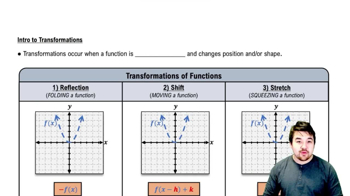
Function transformation refers to the changes made to the graph of a function based on modifications to its equation. Common transformations include vertical and horizontal shifts, stretches, and reflections. For example, the expression f(2(x - 1)) indicates a horizontal shift to the right by 1 unit and a horizontal compression by a factor of 2.
Recommended video:
Guided course
5:25
Intro to Transformations

Horizontal Stretch and Compression

Horizontal stretch and compression involve altering the width of the graph of a function. A factor greater than 1 compresses the graph, making it narrower, while a factor between 0 and 1 stretches it, making it wider. In the function f(2(x - 1)), the '2' compresses the graph horizontally, affecting how quickly the function values change as x varies.
Recommended video:
Guided course
5:25
Intro to Transformations

Graphing Composite Functions

Graphing composite functions involves plotting the output of one function as the input to another. In this case, f(2(x - 1)) means we first apply the transformation to x, then evaluate the function f at that transformed value. Understanding how to graph composite functions is essential for visualizing the effects of transformations on the original function's graph.
Recommended video:
3:48
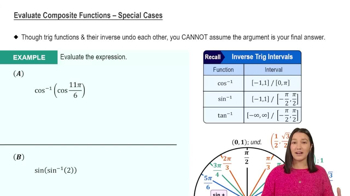
Evaluate Composite Functions - Special Cases