Ch. 1 - Functions
Briggs - Calculus: Early Transcendentals 3rd Edition
Briggs3rd EditionCalculus: Early TranscendentalsISBN: 9780136847243Not the one you use?Change textbook
Chapter 1, Problem 16f

Use the table to evaluate the given compositions. <IMAGE>


h(h(h(0)))

Verified step by step guidance
1
Identify the function h(x) from the given table.
Find the value of h(0) using the table.
Use the result from the previous step to find h(h(0)).
Use the result from the previous step to find h(h(h(0))).
Verify each step using the table to ensure accuracy.

Verified video answer for a similar problem:

This video solution was recommended by our tutors as helpful for the problem above.
Video duration:
2m
Was this helpful?

Key Concepts

Here are the essential concepts you must grasp in order to answer the question correctly.

Function Composition

Function composition involves combining two or more functions to create a new function. If you have functions f(x) and g(x), the composition f(g(x)) means you apply g first and then apply f to the result. Understanding how to evaluate compositions is crucial for solving problems that involve multiple functions.
Recommended video:
3:48
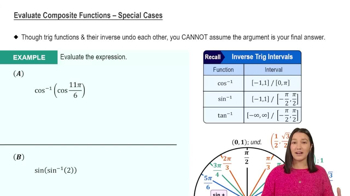
Evaluate Composite Functions - Special Cases

Evaluating Functions

Evaluating a function means substituting a specific input value into the function to find the output. For example, if h(x) is a function, then h(0) means you replace x with 0 in the function h. This process is essential for determining the values needed when working with function compositions.
Recommended video:
4:26
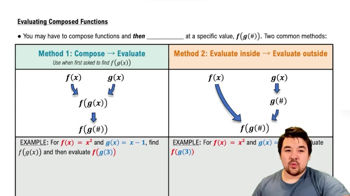
Evaluating Composed Functions

Iterated Functions

Iterated functions refer to applying a function multiple times in succession. In the expression h(h(h(0))), the function h is applied three times, starting with the input 0. Understanding how to iterate functions is important for evaluating complex compositions and determining the final output.
Recommended video:
06:21
Properties of Functions