
Ch. 3 - Derivatives
Briggs - Calculus: Early Transcendentals 3rd Edition
Briggs3rd EditionCalculus: Early TranscendentalsISBN: 9780136847243Not the one you use?Change textbook
Chapter 3, Problem 3.5.62

Find y'' for the following functions.
y = tan x

Verified step by step guidance
1
Start by identifying the function y = tan(x). To find the second derivative y'', we first need to find the first derivative y'.
Recall the derivative of tan(x) with respect to x is sec^2(x). Therefore, y' = sec^2(x).
Next, we need to find the derivative of y' to obtain y''. This means we need to differentiate sec^2(x) with respect to x.
Use the chain rule to differentiate sec^2(x). Let u = sec(x), then y' = u^2. The derivative of u^2 with respect to x is 2u * du/dx.
Now, find du/dx where u = sec(x). The derivative of sec(x) is sec(x)tan(x). Substitute back to get y'' = 2sec(x) * sec(x)tan(x) = 2sec^3(x)tan(x).

Verified video answer for a similar problem:

This video solution was recommended by our tutors as helpful for the problem above.
Video duration:
3m
Was this helpful?

Key Concepts

Here are the essential concepts you must grasp in order to answer the question correctly.

Second Derivative

The second derivative of a function measures the rate of change of the first derivative. It provides information about the concavity of the function and can indicate points of inflection where the function changes from concave up to concave down or vice versa. In this context, finding y'' involves differentiating the function y = tan x twice.
Recommended video:
06:02
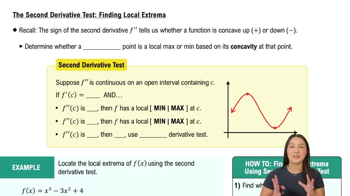
The Second Derivative Test: Finding Local Extrema

Differentiation Rules

Differentiation rules are formulas and techniques used to compute the derivative of functions. Key rules include the power rule, product rule, quotient rule, and chain rule. For the function y = tan x, the derivative can be found using the quotient rule, as tan x can be expressed as sin x / cos x.
Recommended video:
05:53
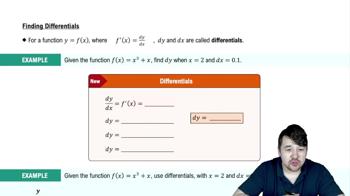
Finding Differentials

Trigonometric Derivatives

Trigonometric derivatives are specific derivatives of trigonometric functions, which have unique rates of change. For example, the derivative of tan x is sec² x. Understanding these derivatives is essential for solving problems involving trigonometric functions, such as finding the second derivative of y = tan x.
Recommended video:
06:35
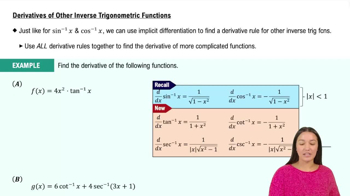
Derivatives of Other Inverse Trigonometric Functions