Ch. 2 - Limits
Briggs - Calculus: Early Transcendentals 3rd Edition
Briggs3rd EditionCalculus: Early TranscendentalsISBN: 9780136847243Not the one you use?Change textbook
Chapter 2, Problem 2.5.56c

Complete the following steps for the given functions. 


c. Graph f and all of its asymptotes with a graphing utility. Then sketch a graph of the function by hand, correcting any errors appearing in the computer-generated graph.


f(x)=3x22x+53x+4f\(\left\)(x\(\right\))=\(\frac{3x^2-2x+5}{3x+4}\)

Verified step by step guidance
1
Step 1: Identify the vertical asymptotes by setting the denominator equal to zero and solving for x. For the function \( f(x) = \frac{3x^2 - 2x + 5}{3x + 4} \), set \( 3x + 4 = 0 \) and solve for x.
Step 2: Determine the horizontal asymptote by comparing the degrees of the numerator and the denominator. Since the degree of the numerator (2) is greater than the degree of the denominator (1), there is no horizontal asymptote. Instead, find the oblique asymptote by performing polynomial long division.
Step 3: Perform polynomial long division of \( 3x^2 - 2x + 5 \) by \( 3x + 4 \) to find the oblique asymptote. The quotient will give the equation of the oblique asymptote.
Step 4: Use a graphing utility to plot the function \( f(x) = \frac{3x^2 - 2x + 5}{3x + 4} \) along with the asymptotes identified in the previous steps. Observe the behavior of the graph near the asymptotes.
Step 5: Sketch the graph by hand, ensuring to correct any discrepancies observed in the computer-generated graph, particularly around the asymptotes and any intercepts.

Verified video answer for a similar problem:

This video solution was recommended by our tutors as helpful for the problem above.
Video duration:
3m
Was this helpful?

Key Concepts

Here are the essential concepts you must grasp in order to answer the question correctly.

Asymptotes

Asymptotes are lines that a graph approaches but never touches. They can be vertical, horizontal, or oblique. Vertical asymptotes occur where the function is undefined, typically at values that make the denominator zero. Horizontal asymptotes describe the behavior of a function as x approaches infinity, indicating the value the function approaches. Understanding asymptotes is crucial for accurately sketching the behavior of rational functions.
Recommended video:
5:37
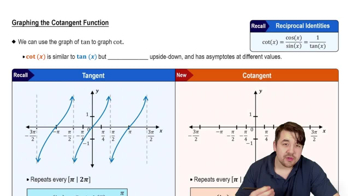
Introduction to Cotangent Graph

Graphing Rational Functions

Graphing rational functions involves plotting the function defined as the ratio of two polynomials. Key steps include identifying intercepts, asymptotes, and the end behavior of the function. The degree of the numerator and denominator helps determine the horizontal asymptote, while factoring can reveal vertical asymptotes. A graphing utility can assist in visualizing these features, but manual sketching allows for correction of any inaccuracies.
Recommended video:
5:53
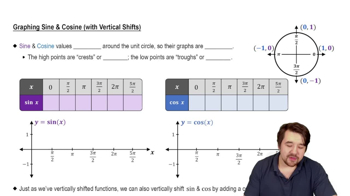
Graph of Sine and Cosine Function

End Behavior

End behavior refers to the behavior of a function as the input values approach positive or negative infinity. For rational functions, this is influenced by the degrees of the numerator and denominator. If the degree of the numerator is less than that of the denominator, the function approaches zero; if they are equal, it approaches the ratio of their leading coefficients. Understanding end behavior is essential for predicting how the graph behaves far from the origin.
Recommended video:
03:07
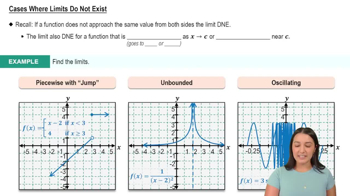
Cases Where Limits Do Not Exist