
23–68. Indefinite integrals Determine the following indefinite integrals. Check your work by differentiation.
∫ (√x(2x⁶ - 4³√)dx
Verified step by step guidance
1
Rewrite the integral to simplify the expression. Break down the terms inside the integral: \( \int \sqrt{x}(2x^6 - 4\sqrt[3]{x}) \, dx \). Recall that \( \sqrt{x} = x^{1/2} \) and \( \sqrt[3]{x} = x^{1/3} \). Distribute \( x^{1/2} \) across the terms inside the parentheses.
After distributing, the integral becomes \( \int (2x^{6 + 1/2} - 4x^{1/2 + 1/3}) \, dx \). Simplify the exponents by adding the powers: \( 6 + 1/2 = 13/2 \) and \( 1/2 + 1/3 = 3/6 + 2/6 = 5/6 \). The integral is now \( \int (2x^{13/2} - 4x^{5/6}) \, dx \).
Apply the power rule for integration: \( \int x^n \, dx = \frac{x^{n+1}}{n+1} + C \), where \( n \neq -1 \). Integrate each term separately. For the first term, \( 2x^{13/2} \), the new exponent is \( 13/2 + 1 = 15/2 \), and the coefficient becomes \( \frac{2}{15/2} = \frac{4}{15} \). For the second term, \( -4x^{5/6} \), the new exponent is \( 5/6 + 1 = 11/6 \), and the coefficient becomes \( \frac{-4}{11/6} = \frac{-24}{11} \).
Combine the results of the integration. The indefinite integral becomes \( \frac{4}{15}x^{15/2} - \frac{24}{11}x^{11/6} + C \), where \( C \) is the constant of integration.
Check your work by differentiating the result. Differentiate \( \frac{4}{15}x^{15/2} - \frac{24}{11}x^{11/6} + C \) term by term using the power rule for differentiation: \( \frac{d}{dx}x^n = nx^{n-1} \). Verify that the derivative matches the original integrand \( \sqrt{x}(2x^6 - 4\sqrt[3]{x}) \).
Verified video answer for a similar problem:
This video solution was recommended by our tutors as helpful for the problem above
Video duration:
3m
Play a video:
0 Comments
Key Concepts
Here are the essential concepts you must grasp in order to answer the question correctly.
Indefinite Integrals
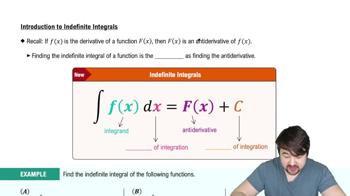
Indefinite integrals represent a family of functions whose derivative is the integrand. They are expressed with the integral sign and do not have specified limits, resulting in a general solution plus a constant of integration (C). Understanding how to compute indefinite integrals is crucial for solving problems in calculus, as they are foundational to the concept of antiderivatives.
Various techniques are used to evaluate integrals, including substitution, integration by parts, and recognizing standard forms. For the given integral, recognizing the structure of the integrand, such as factoring or simplifying expressions, can facilitate the integration process. Mastery of these techniques is essential for effectively solving more complex integrals.
After finding an indefinite integral, it is important to verify the result by differentiating the antiderivative obtained. This process ensures that the derivative of the antiderivative returns to the original integrand. This verification step is a critical part of the integration process, confirming the accuracy of the solution and reinforcing the relationship between differentiation and integration.