
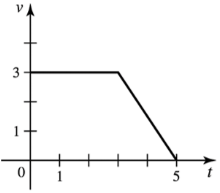
17–22. Position from velocity Consider an object moving along a line with the given velocity v and initial position.
a. Determine the position function, for t≥0, using the antiderivative method
v(t) = 9−t² on [0, 4]; s(0)=−2
Verified step by step guidance
17–22. Position from velocity Consider an object moving along a line with the given velocity v and initial position.
a. Determine the position function, for t≥0, using the antiderivative method
v(t) = 9−t² on [0, 4]; s(0)=−2
Critical depth A large tank has a plastic window on one wall that is designed to withstand a force of 90,000 N. The square window is 2 m on a side, and its lower edge is 1 m from the bottom of the tank.
a. If the tank is filled to a depth of 4 m, will the window withstand the resulting force?
Mass of two bars Two bars of length L have densities ρ₁(x) = 4e^−x and ρ₂(x) = 6e^−2x, for 0≤x≤L.
a. For what values of L is bar 1 heavier than bar 2?
Determine whether the following statements are true and give an explanation or counterexample.
a. If the curve y=f(x) on the interval [a, b] is revolved about the y-axis, the area of the surface generated is ∫f(b)f(a) 2πf(y)√1+f′(y)^2 dy.
21–30. {Use of Tech} Arc length by calculator
a. Write and simplify the integral that gives the arc length of the following curves on the given interval.
y = ln x, for 1≤x≤4
For the given regions R₁ and R₂, complete the following steps.
a. Find the area of region R₁.
R₁is the region in the first quadrant bounded by the line x=1 and the curve y=6x(2−x^2)^2; R₂ is the region in the first quadrant bounded the curve y=6x(2−x^2)^2and the line y=6x.