
Textbook Question
9–30. The Ratio and Root Tests Use the Ratio Test or the Root Test to determine whether the following series converge absolutely or diverge.
∑ (from k = 1 to ∞) (2ᵏ / k⁹⁹)
52
views

 Verified step by step guidance
 06:00
06:00
 06:52 06:00
9–30. The Ratio and Root Tests Use the Ratio Test or the Root Test to determine whether the following series converge absolutely or diverge.
∑ (from k = 1 to ∞) (2ᵏ / k⁹⁹)
35–44. Limits of sequences Write the terms a₁, a₂, a₃, and a₄ of the following sequences. If the sequence appears to converge, make a conjecture about its limit. If the sequence diverges, explain why.
aₙ = 3 + cos(π*ⁿ) ; n = 1, 2, 3, …
Limits of sequences
Find the limit of the following sequences or determine that the sequence diverges.
{nsin(6 / n)}
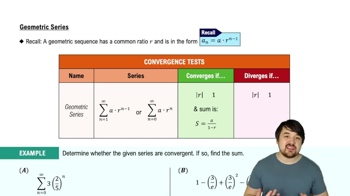
21–42. Geometric series Evaluate each geometric series or state that it diverges.
25.∑ (k = 0 to ∞) 0.9ᵏ
11–27. Alternating Series Test Determine whether the following series converge.
∑ (k = 1 to ∞) (−1)ᵏ (k¹¹ + 2k⁵ + 1) / [4k(k¹⁰ + 1)]
23–38. Divergence, Integral, and p-series Tests Use the Divergence Test, the Integral Test, or the p-series test to determine whether the following series converge.
∑ (k = 1 to ∞) 1 / ∛k