
Textbook Question
Finding Limits
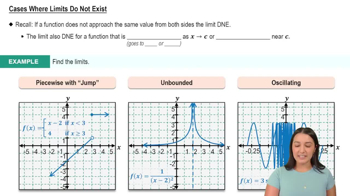
In Exercises 3–8, find the limit of each function (a) as x → ∞ and (b) as x → −∞. (You may wish to visualize your answer with a graphing calculator or computer.)
h(x) = (−5 + (7/x))/(3 – (1/x²))
262
views

 Verified step by step guidance
 03:07
03:07
 6:04
6:04 2:02
2:02Finding Limits
In Exercises 3–8, find the limit of each function (a) as x → ∞ and (b) as x → −∞. (You may wish to visualize your answer with a graphing calculator or computer.)
h(x) = (−5 + (7/x))/(3 – (1/x²))
Graphing Simple Rational Functions
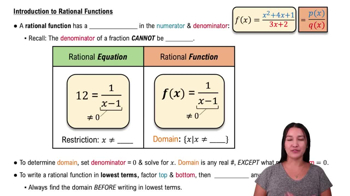
Graph the rational functions in Exercises 63–68. Include the graphs and equations of the asymptotes and dominant terms.
y = 1/(x − 1)
Using the Formal Definitions
Use the formal definitions of limits as x → ±∞ to establish the limits in Exercises 91 and 92.
If f has the constant value f(x) = k, then lim x → ∞ f(x) = k.
Define h(2) in a way that extends h(t) = (t² + 3t − 10)/(t − 2) to be continuous at t = 2.
For what values of a and b is
g(x) = { ax + 2b, x ≤ 0
x² + 3a – b, 0 < x ≤ 2
3x – 5, x > 2
continuous at every x?
Using the Formal Definition
Prove the limit statements in Exercises 37–50.
limx→9 √(x − 5) = 2